Rio+20 Just say NO to Geoengineering
Submitted by ETC Staff on


Submitted by ETC Staff on
Submitted by ETC Staff on

It’s difficult to describe Rio+20 as anything other than a tragedy. Despite years of preparation and months of negotiations, nothing said or done in Rio can cover up not just the 20 lost years since the original 1992 Earth Summit – as seasoned delegates have quietly noted – but also the half-century of intergovernmental failures since Rachel Carson catalyzed the sequence of global environmental congresses following the publication of her book, Silent Spring, in 1962.
Submitted by ETC Staff on
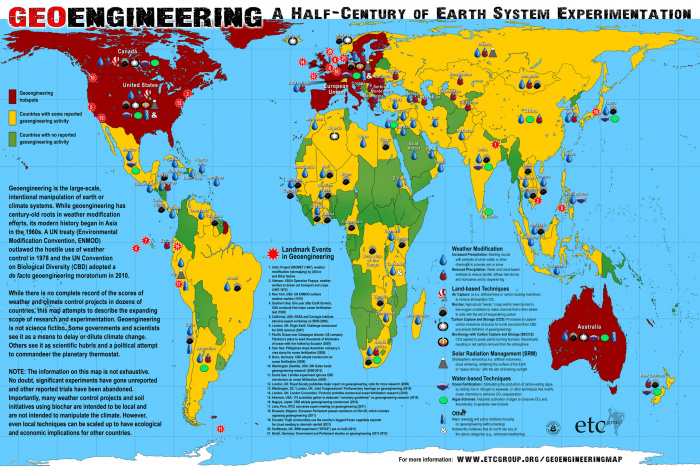
ETC Group publishes a world map of geoengineering -- the large-scale manipulation of earth or climate systems. While there is no complete record of the scores of weather and climate control projects in dozens of countries, this map is the first attempt to document the expanding scope of research and experimentation. Almost 300 geoengineering projects/experiments are represented on the map belonging to 10 different types of climate-altering technologies.
Submitted by ETC Staff on
Hands Off Mother Earth (H.O.M.E) is a global campaign to defend our one precious home, Planet Earth, against the threat of geoengineering experiments. You can join the campaign at http://www.handsoffmotherearth.org
Submitted by ETC Staff on
Although Rio+20 negotiators are discussing marine applications of geoengineering (so-called “ocean fertilization”) in the context of climate change and technological “quick fixes,” the wider issues of geoengineering, including so-called solar radiation management, are not being discussed. The UN Convention on Biological Diversity established a de facto moratorium on all forms of geoengineering in 2010. Nevertheless, some governments are continuing to look toward technological methods of blocking or reflecting sunlight and other planetary system adjustments. Rio+20 should make a firm statement banning geoengineering to prevent a handful of countries -- a new “coalition of the willing” from taking the Earth’s thermostat into their own hands.
Submitted by ETC Staff on

ndustry statistics on world energy consumption put the “Green Economy” in much-needed perspective: In 2010 the world’s energy consumption grew by 5.6% - faster than any year since 1973.31 Fossil fuels accounted for 88% of the world’s primary energy (oil 34%; coal 30%; gas 24%). Nuclear, hydroelectric and “renewables” account for the remaining 12%. Non-hydro “renewables” (wind, geothermal, solar, biomass and waste) – including biofuels – account for 1.8% global energy consumption. World biofuels production grew by 14% in 2010 – but accounted for just one-half of one percent of global primary energy consumption. The world's top 10 energy companies account for 25% of the estimated $7 trillion energy market. Many of the world’s largest energy enterprises are high-profile investors in synthetic biology. Not only do they seek a cleaner, greener image; they believe that future profits will depend on diversifying and controlling bio-based feedstocks for energy production.
Submitted by ETC Staff on

Even as new industrial platforms involving petrochemicals and electricity were gaining ground in the late nineteenth century, the newly formed United States Department of Agriculture (USDA) unveiled its official seal showing a plow with sheaves of maize depicted on the surface of a shield. Below the shield, an unfurled scroll bears the claim: AGRICULTURE IS THE FOUNDATION OF MANUFACTURE AND COMMERCE.
As the 20th century evolved, petrochemicals and their associated technologies displaced agriculture as the economy’s foundation, but the 21st century may see a return of agriculture’s primacy. The vision is of a transformed and transformative agriculture, however, where both input (i.e., feedstock and feedstock processing) and output are tailor-made for particular industrial uses. Commodity crops may no longer be identified in the traditional way; in the future, they’ll be engineered, proprietary products custom-designed to meet the needs of industrial biomass processors – whether for food, energy, materials or pharmaceuticals.
Submitted by ETC Staff on

International efforts to address the food, energy and climate crises give technology a central role to play. While some technologies may offer potential solutions to specific problems, decades of accelerating technological development and deployment have done little to mitigate climate change, and, in many cases, have made problems worse.
Now, new high-risk technologies, ranging from the very small (synthetic biology, genomics, nanotechnology) to the very large (geoengineering), are rapidly developing. Their promoters promise that these technologies are key to solving climate change,
world hunger, energy shortages and biodiversity loss. The precautionary principle and social and economic impacts are often ignored in the rush to deploy the latest technofix, marketed as socially useful and cutting edge, such as “climate-smart agriculture” or “next-generation biofuels.” Without the strict application of the precautionary principle, and a transparent and participatory form of technology assessment, new technologies could wreak even more havoc on a fragile planet that is already under immense strain due to reckless and unsustainable forms of production that serve the few at the expense of the many.
Submitted by ETC Staff on
he most dramatic technological transformation in history – involving information technologies, biotechnologies and engineering – has occurred since the first Rio Earth Summit in 1992; during the same period, however, governments have systematically downsized or eliminated their capacity to understand science and monitor technologies. While technology has thus far played an extraordinarily prominent role in preparatory documents for Rio+20, technology’s potential contribution to sustainable development and/or new Green Economies cannot be realized as long as the world lacks trusted and transparent mechanisms – at global, regional and national levels – for technology evaluation. The absence of such mechanisms incites distrust and invites disaster.
Submitted by ETC Staff on

Earth Grab - Geopiracy, the New Biomassters and Capturing Climate Genes' - essential, cutting-edge climate science in everyday language - published this week (27 October 2011). The authors reveal information that the large corporations who profit from climate change do not want the public to know.
'Earth Grab' analyses how Northern governments and corporations are cynically using concerns about the ecological and climate crisis to propose geoengineering 'quick fixes'. These threaten to wreak havoc on ecosystems, with disastrous impacts on the people of the global South. As calls for a 'greener' economy mount and oil prices escalate, corporations are seeking to switch from oil-based to plant-based energy.
minent environmentalist Vandana Shiva, founder of the Research Foundation for Science, Technology and Ecology, writes in her foreword that this research 'pulls back the curtain on disturbing technological and corporate trends that are already reshaping our world and that will become crucial battlegrounds for civil society in the years ahead'.
The book has already captured the attention of writer Naomi Klein, who writes that this 'crucial book reveals ... Indispensable research for those with their eyes wide open'. Campaigner George Monbiot adds that its exploration of 'three crucial issues which will come to dominate environmental and human rights debates in the coming years make it an essential resource for anyone trying to keep up with the times'.
This roundtable discussion with Pat Mooney was organized jointly by the What Next Forum and The Resilience and Development Programme (SwedBio) at Stockholm Resilience Centre.
All together 19 persons, with backgrounds in civil society, the Swedish Ministry for Environment, the Swedish EPA, the research community and sustainable development consultancy participated in a rich discussion, initiated and inspired by an overview by Mooney.
Submitted by ETC Staff on
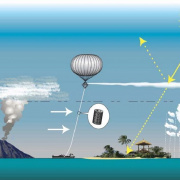
Opponents of proposals to “geoengineer” the planet have two reasons to celebrate this week.
Firstly, ETC Group has learned that UK scientists, in the midst of controversy, are on the cusp of postponing an imminent test of an experimental hose (dubbed the “Trojan Hose” by opponents) designed to deliver sulphur dioxide to the stratosphere as a way to engineer a cooler planet. The test had been scheduled for October; on Monday, 60 groups from around the globe sent an open letter to the UK government and the research councils involved expressing their opposition to the experiment. No public announcement of the decision has been made and details must be clarified, but an undeniable lack of prior stakeholder engagement is the likely reason for the delay.
Submitted by ETC Staff on
Over 50 concerned groups from around the world are calling on people to sign an open letter (here) asking the UK Government and Research Councils to scrap the controversial SPICE experiment designed to test hardware for deployment of stratospheric aerosol injections as a way to artificially cool the planet.
Submitted by ETC Staff on
We are writing to express our concern about the SPICE research project, which is managed by the University of Bristol in collaboration with the Universities of Oxford, Cambridge and Edinburgh, as well as military contractor Marshall Aerospace. The £1.6 million project has been funded by the Engineering and Physical Sciences Research Council (EPSRC) and the Natural Environment Research Council (NERC), supported by the Science and Technology Facilities Council (STFC). We are calling upon the UK government and the Research Councils involved to suspend the project. In particular, we believe the experiment planned to test equipment for injecting particles into the stratosphere with the aim of counteracting global warming through solar radiation management (SRM) should be cancelled.
Submitted by ETC Staff on
In response to reports that British scientists are about to test the hardware needed to put sulphur particles in the stratosphere as a climate technofix, international technology watchdog ETC Group is calling on the UK government to halt the controversial test and respect UN processes underway to discuss these issues.
Submitted by ETC Staff on

As the Intergovernmental Panel on Climate Change (IPCC) wound up its expert meeting on geoengineering in Lima, Peru, which included all three IPCC Working Groups, it committed to remain “policy relevant but not policy prescriptive.” Despite getting off on the wrong foot (no transparency), with some of the wrong experts (scientists with financial interests), on some of the wrong topics (governance), the IPCC has now confirmed that it will not make recommendations to governments regarding research funding for the controversial technologies, governance models or the legality of experimentation.
At a press briefing following the close of the expert meeting, the IPCC stated that its focus will be “establishing the scientific foundations for an assessment of geoengineering.” This assessment would include risks, costs, benefits and social and economic impacts, intended and unintended consequences as well as uncertainties and gaps in knowledge and will be based solely on peer-reviewed literature. “Of course, a real assessment of geoengineering will need to be much broader than a scientific peer-review process,” said Silvia Ribeiro of ETC Group from Lima, though outside the meeting. “Civil society organizations have been clear that we do not want these dangerous technologies developed; they are a new threat from the very same countries that are responsible for the climate crisis in the first place!”
Submitted by ETC Group on
125 international and national organizations, representing at least 40 countries from all continents, sent an open letter to the Intergovernmental Panel on Climate Change (IPCC), demanding a clear statement of its commitment to precaution and to the existing international moratorium on geoengineering. The IPCC will hold an expert meeting on geoengineering 20-22 June in Lima, Peru.
Submitted by ETC Staff on

The undersigned organizations would like to express our concerns about the upcoming IPCC joint working group expert meeting on geoengineering to be held in Lima, Peru, June 20-22, 2011.
Submitted by ETC Group on

Next year’s UN conference in Rio de Janeiro should mark the beginning of a new era of environmental and economic cooperation. Rio +20 is not only the 20th anniversary of the Earth Summit, it is also Stockholm+40 – marking the UN’s first major environmental conference, and, somewhat ominously, it is also the 50th anniversary of the publication of Rachel Carson’s groundbreaking Silent Spring. As we prepare for 2012, we have 50 years of environmental history to bear in mind.

Find out more about ETC Group, or contact us.