Recent content

News release: Geoengineering Moratorium at UN Ministerial in Japan

Risky Climate Techno-fixes Blocked

In a landmark consensus decision, the 193-member UN Convention on Biological Diversity (CBD) closed its tenth biennial meeting with a de facto moratorium on geoengineering projects and experiments. “Any private or public experimentation or adventurism intended to manipulate the planetary thermostat will be in violation of this carefully crafted UN consensus,” stated Silvia Ribeiro, Latin American Director of ETC Group.

¡Moratoria a la geoingeniería!

La ONU bloquea riesgosos remiendos técnicos para el cambio climático

Los 193 países firmantes del Convenio sobre Diversidad Biológica (CDB) cerraron su décima reunión bianual con una memorable decisión consensada: establecer una moratoria de facto sobre los proyectos y experimentos de geoingeniería. "Cualquier experimento, sea de fuente pública o privada que intente ahora manipular el termostato planetario violará este consenso de Naciones Unidas, que fue cuidadosamente logrado", afirmó Silvia Ribeiro, Directora para Latinoamérica del Grupo ETC.

Moratoire sur la géoingénierie à la rencontre ministérielle des Nations Unies au Japon

À la rencontre ministérielle des Nations Unies au Japon

À la suite d’une décision par consensus sans précédent, la Conférence des 193 parties à la Convention des Nations Unies sur la diversité biologique (CDB) s’apprête à conclure sa dixième rencontre biennale avec l’adoption d’un moratoire de facto sur les projets et les expériences en géoingénierie. « Toute expérimentation, privée ou publique, ou tout aventurisme visant à manipuler le thermostat planétaire constituera une violation de ce consensus soigneusement élaboré dans le contexte des Nations Unies », a affirmé Silvia Ribeiro, directrice de l’ETC Group pour l’Amérique latine.

Media Advisory: Press Conference on CBD Geoengineering Moratorium

ETC Group, an international civil society organization that monitors new technologies, explains and comments on the Convention on Biological Diversity’s COP 10 consensus decision to adopt a moratorium on geoengineering.  Webcast of the press conference given by ETC Group representatives at http://webcast.cop10.go.jp. (link not active)

The speakers:

Mr. Pat Mooney  - Executive Director, ETC Group (Canada)
Ms. Silvia Ribeiro – Director Latin America, ETC Group (Mexico)


Reporte sobre “cultivos climáticos”

Las corporaciones más grandes del mundo de semillas y agroquímicos están llenando cientos de solicitudes de patentes de amplísimo espectro sobre genes múltiples, en una apuesta por controlar la biomasa vegetal del planeta, según el informe del Grupo ETC publicado este lunes 25 de octubre.

Un puñado de corporaciones multinacionales están presionando a los gobiernos para que acepten, mediante el sistema de patentes, el apropiamiento de la biodiversidad más amplio y peligroso de la historia, advierte el Grupo ETC en Nagoya, durante la reunión del Convenio sobre Diversidad Biológica. (18 al 29 de octubre de 2010).

New Report on Gene Giants and “Climate-Ready” Crops

Under the guise of developing “climate-ready” crops, the world’s largest seed and agrochemical corporations are filing hundreds of sweeping, multi-genome patents in a bid to control the world’s plant biomass, according to a report released by ETC Group today.

A handful of multinational corporations are pressuring governments to allow what could become the broadest and most dangerous patent claims in history, warns the group at the United Nations’ Convention on Biodiversity in Nagoya, Japan (18-29 October 2010).

Capturing 'Climate Genes'

Gene Giants Stockpile Patents on “Climate-Ready” Crops in Bid to Become Biomassters

The world’s six largest agrochemical and seed corporations are filing sweeping, multi-genome patents in pursuit of exclusive monopoly over plant gene sequences. Marketed as crops genetically-engineered to withstand environmental stresses such as drought, heat, cold, floods, saline soils, and more, this development could lead to control of most of the world’s plant biomass – whether it is used for food, feed, fibre, fuel or plastics. Under the guise of developing “climate-ready” crops as a silver bullet solution to climate change, these companies are pressuring governments to allow the broadest and potentially most dangerous patent claims in intellectual property history. But can patented techno-fix seeds provide the adaptation strategies that small farmers need to cope with climate change? On the contrary, these proprietary technologies are poised to concentrate corporate power, drive up costs, inhibit independent research, and further undermine the rights of farmers to save and exchange seeds. For the “Gene Giants,” the goal is “biomasstery” – to profit from the world’s biomass.

En el CDB, la sociedad civil llama a moratoria sobre la geoingeniería

Precauciones extremas ante riesgos extremos, exigen grupos

Uno de los temas más controvertidos que enfrenta el Convenio sobre Diversidad Biológica (CDB) en Nagoya, Japón, es la moratoria sobre los experimentos de geoingeniería que se están proponiendo como una de las soluciones a la crisis del clima. Durante la plenaria de apertura la alianza de organizaciones de la sociedad civil llamó a establecer definitivamente una moratoria sobre los experimentos de geoingeniería.

La ONU discutirá soluciones de ciencia ficción para el cambio climático en reunión sobre biodiversidad

La sociedad civil llama a la precaución

Mientras funcionarios de 193 países hacen el recuento de la dramática pérdida de biodiversidad en la 10a Conferencia de las Partes del Convenio sobre Diversidad Biológica en Nagoya, Japón, del 18 al 29 de octubre de 2010, el Grupo ETC advierte que se están promoviendo “remedios técnicos” muy riesgosos como la solución a la crisis climática, y que deben congelarse.

La reunión global, que marca el Año Internacional de la Biodiversidad, debatirá una moratoria de facto sobre la liberación al ambiente de las formas de vida artificiales (una variante de la ingeniería genética extrema, promovida por la industria como fundamento de una “economía verde”) y también se discutirá una prohibición de las actividades de geoingeniería (manipulación en gran escala de los sistemas de la Tierra). Las leyes internacionales existentes no tienen control adecuado para estas controvertidas nuevas tecnologías.

El Grupo ETC presentará tres nuevos informes y celebrará tres eventos en Nagoya sobre esos remedios de ciencia ficción, en los cuales denunciará los intereses que los respaldan y los riesgos inherentes de desarrollarlos sin control alguno.

Civil Society Calls for Moratorium on Geoengineering

Extreme Risk Calls for Extreme Precaution

One of the hottest issues before the Convention on Biological Diversity (CBD) in Nagoya, Japan is a set of crucial decisions that could bring about a moratorium on proposed experiments in geoengineering, a set of high-risk climate technofixes. At the opening plenary of the conference, the CBD Alliance on behalf of civil society organizations called for a moratorium on geoengineering experiments.

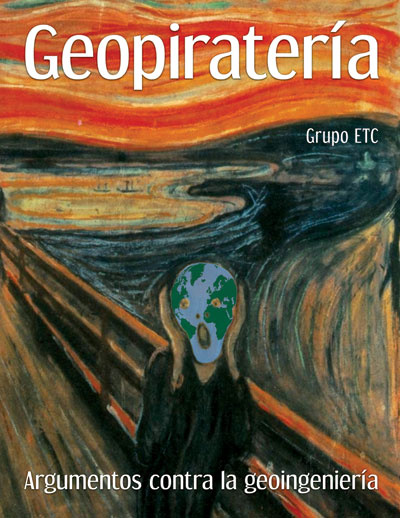
Geopiracy: The Case Against Geoengineering

This report exposes the new climate 'Plan B' for what it is: a political strategy aimed at letting industrialized countries off the hook for their climate debt. From adjusting the global thermostat to changing the chemistry of our oceans, these technofixes are a threat to people and the planet. The report contains an overview of the history, the science, the interests behind their rapid development and the international governance issues at stake.

Issue:

Realpolitik, we are advised, recognizes that the multilateral system can’t produce an equitable or effective agreement that will mitigate climate chaos: Recognizing this, concerned governments and scientists have no reasonable choice but to investigate technological strategies that could reduce or delay climate change, at least until social forces make a practical agreement possible. Also according to Realpolitik, there is no more hope of achieving a multilateral consensus on re-jigging the thermostat than there is of adopting effective targets for greenhouse gas (GHG) emissions. Therefore, the issue is to create a narrative and construct a governance model that will allow a courageous, far-sighted, science- based “coalition of the willing” to justify their unilateral manipulation of the Earth’s systems. They call it geoengineering – we call it geopiracy.

Máquinas de guerra: Blackwater, Monsanto y Bill Gates

Máquinas de guerra: Blackwater, Monsanto y Bill Gates
Español

Un reporte de Jeremy Scahill publicado en The Nation (Blackwater’s Black Ops, 15/9/2010) reveló que el ejército mercenario más grande del mundo, Blackwater (ahora llamado Xe Services) le vendió servicios clandestinos de espionaje a la trasnacional Monsanto. Blackwater cambió de nombre en 2009, luego de hacerse famosa en el mundo por las denuncias sobre sus abusos en Irak, incluidas masacres de civiles.

UN to Confront Sci-fi Climate Solutions at Biodiversity Meeting

Civil Society Calls for Precaution

As environment ministers from 193 countries take stock of the globe’s dramatic loss of biodiversity at the Convention on Biological Diversity (CBD) in Nagoya, Japan next week (18-29 October 2010), ETC Group warns that high-risk “technological fixes” that claim to hold the key for solving the climate crisis should be put on ice.

The global meeting, marking the International Year of Biodiversity, will debate a de facto moratorium on the release into the environment of synthetic life forms (a form of extreme genetic engineering marketed by industry as the building blocks of the “green economy”) and on geoengineering activities (massive intentional manipulations of the Earth’s systems). Existing international law has no adequate controls for these controversial new technologies.

ETC Group released three new reports on these technofixes, explaining the interests behind them and the risks inherent in their uncontrolled development.

Información para la COP 10 del CBD en Nagoya: Biología Sintética

BIOLOGÍA SINTÉTICA: Creando vida artificial

Mientras la Conferencia de las Partes (COP) considera directrices para los temas nuevos e incipientes que pueden tener implicaciones sobre la biodiversidad, y lucha por la adopción de un protocolo sobre acceso y reparto de beneficios (ABS), la industria de la biología sintética desarrolla rápidamente la capacidad de construir formas de vida sintéticas. Las repercusiones de esto para la diversidad biológica son desconocidas, pero podrían ser devastadoras. Además, mediante biología sintética se puede manipular los organismos naturales de forma mucho más vasta que antes, lo cual además abre las puertas para nuevas patentes monopólicas fuera del control de los Estados o de los pueblos indígenas.

ETC Group Briefing for CBD COP 10 in Nagoya: Synthetic Biology

Recommendations for CBD Delegates

As the Conference of the Parties (COP) to the Convention on Biological Diversity (CBD) ponders guidelines for considering new and emerging issues that may have implications for biodiversity – and struggles to adopt a protocol on access and benefit sharing (ABS) – researchers in synthetic biology are developing the capacity to construct synthetic life forms. The repercussions for biological diversity are unknown but could be devastating. Natural organisms, too, may be “tweaked” using synthetic biology to allow for patent monopolies beyond the reach of state sovereignty or of indigenous peoples.

Vendiendo aire

Vendiendo aire
Español

por Silvia Ribeiro Avanza uno de los más increíbles ataques a los bienes comunes del planeta y la humanidad: la privatización del aire.  La principal herramienta para ello es un mecanismo llamado cínicamente REDD (Reducción de emisiones por deforestación y/o degradación evitada de bosques), que está entre los puntos clave que promueve el gobierno mexicano en las negociaciones internacionales sobre el clima. La propuesta de los programas REDD es que como la deforestación es un factor importante de la crisis climática, hay que compensar económicamente a quienes dejen de deforestar.

Nature Communications article shows 'true colours' of biochar advocates

Groups condemn implied land-grab for biochar

Press Release by African Biodiversity Network, Amigransa Venezuela, Biofuelwatch, CESTA (Friends of the Earth El Salvador), COECOCEIBA Costa Rica, Econexus, ETC Group, FASE Brasil, Gaia Foundation, Global Forest Coalition, Global Justice Ecology Project, Latin American Network against Monoculture Tree Plantations (RECOMA), NOAH Food and Agriculture (FoE Denmark), Observatorio de Conflictos Ambientales (OLCA) Chile, Otros Mundos Mexico, Rettet den Regenwald, Salva la Selva, Save America's Forests, Sobrevivencia (Friends of the Earth Paraguay) Timberwatch Coalition and World Rainforest Movement

Twenty one groups today expressed their dismay at an article by leading biochar advocates, published by the science magazine Nature, which proposes that an area larger than the land mass of India could be turned into charcoal plantations in the name of climate change mitigation.[1] The paper’s own figures contradict the authors’ claims that biochar will not lead to large-scale land grabbing in the global South.

Artículo en Nature Communications muestra las mentiras de los defensores del 'biochar'.

Grupos condenan el robo de tierras que implica la producción del biochar

Boletín de prensa colectivo de African Biodiversity Network, Amigransa Venezuela, Biofuelwatch, CESTA (Amigos de la Tierra El Salvador), COECOCEIBA Costa Rica, Econexus, Grupo ETC, FASE Brasil, Gaia Foundation, Global Forest Coalition, Global Justice Ecology Project, Latin American Network against Monoculture Tree Plantations (RECOMA), Observatorio de Conflictos Ambientales (OLCA) Chile, Otros Mundos Mexico, Rettet den Regenwald Alemania, Salva la Selva España, Save America's Forests, Sobrevivencia (Amigos de la Tierra Paraguay) y el Movimiento Mundial por los Bosques WRM

Celebrando la dependencia: el maíz a las trasnacionales

Celebrando la dependencia: el maíz a las trasnacionales
Español

Por Silvia Ribeiro Como si fuera un hecho banal, el gobierno mexicano aceptó tres solicitudes de la trasnacional Monsanto para plantar 30 mil hectáreas de maíz transgénico en Sinaloa, en lo que llama fase piloto. Es grave, tanto por la amplitud del área, como porque pone de manifiesto que lo que el gobierno llama etapa experimental es nada más una fachada para abrir la siembra comercial de maíz transgénico a gran escala, con la inevitable contaminación transgénica de los demás maíces en el país.

Páginas

Suscribirse a Recent content