Recent content

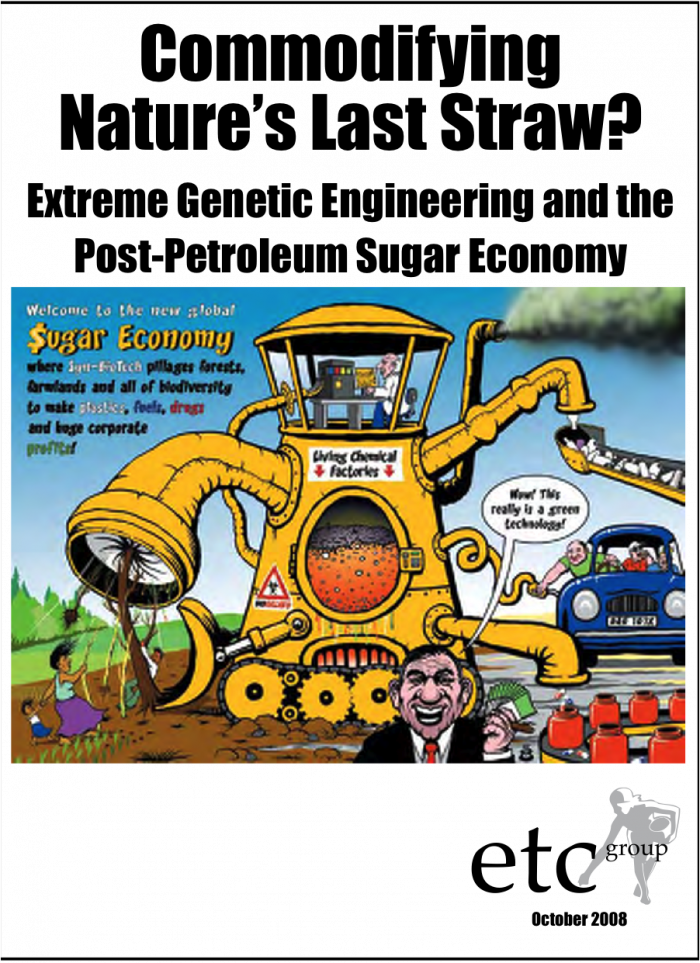
Commodifying Nature's Last Straw?

Extreme Genetic Engineering and the Post-Petroleum Sugar Economy

Peak oil, skyrocketing fuel costs and climate crisis are driving corporate enthusiasm for a “biological engineering revolution” that some predict will dramatically transform industrial production of food, energy, materials, medicine and all of nature. Advocates of converging technologies promise a greener, cleaner post-petroleum future where the production of economically important compounds depends not on fossil fuels – but on biological manufacturing platforms fueled by plant sugars. It may sound sweet and clean, but the so-called “sugar economy” will also be the catalyst for a corporate grab on all plant matter – and destruction of biodiversity on a massive scale.

The Last Straw?

As Extreme Genetic Engineers Gather in Hong Kong, Critics Warn of Corporate Grab on Plant Life: SynBio 4.0 = SynBio-4-profit

Synthetic biologists, a brave new breed of science entrepreneurs who engineer life-forms from scratch, will hold their largest-ever global gathering in Hong Kong, October 10-12 2008, known as "Synthetic Biology 4.0." Although most people have never heard of synthetic biology, it's moving full speed ahead fueled by giant agribusiness, energy and chemical corporations with little debate about who will control the technology, how it will be regulated (or not) and despite grave concerns surrounding the safety and security risks of designer organisms. Corporate investors/partners include BP, Chevron, Shell, Virgin Fuels, DuPont, Microsoft, Cargill and Archer Daniels Midland.

Plastic Plants

Plastic Plants
Inglés


Henry Ford dreamed of making plastic cars out of soy. Now Dow, DuPont and other chemical giants are also dreaming of a ‘green’ future. But, as Jim Thomas argues, bioplastic is not the eco-solution it’s cracked up to be.

Article from New Internationalist Magazine September 2008 issue - available online here

Cómo volver mercancía hasta la última brizna de hierba

Ingenería genética extrema y la economía post-petrolera del azúcar

Debido a la crisis del petróleo, a la escalada en los precios de los combustibles y a la crisis del clima, las corporaciones redirigen su entusiasmo hacia una “revolución de la ingeniería biológica” que algunos auguran transformará dramáticamente la producción industrial de alimentos, energía, materias primas, medicina y la naturaleza entera. Los entusiastas de las tecnologías convergentes prometen una era post-petróleo más verde y limpia, donde la producción de compuestos importantes para la economía no dependerá de los combustibles fósiles, sino de la manufactura de plataformas biológicas alimentadas por azúcares vegetales. Tal vez suene dulce y limpio, pero la llamada “economía del azúcar” también catalizará la voracidad de las corporaciones por toda la materia vegetal —y con ello, la destrucción de la biodiversidad a una escala masiva.

Los nuevos confinamientos de la mente

Capítulo para el libro “Bienes comunes y ciudadanía”

Se puede engañar a algunos todo el tiempo y a todos parte del tiempo, pero no se puede engañar a todos todo el tiempo… Sin embargo, se puede convencer a un número suficiente de gente para monitorearnos a todos, todo el tiempo.

En el contexto de los nuevos asaltos a los bienes comunes, las tecnologías de punta (como la nanotecnología, la genómica, la biología sintética, robótica e informática) ocupan un papel importante, ya que proveen herramientas instrumentales
para nuevas formas de despojo. Separadas, esas tecnologías tienen particularidades y problemas propios, pero los aspectos más peligrosos están en su sinergia y convergencia y el aprovechamiento de éstas por parte de las élites. Tenemos que analizar esto con sumo cuidado, no sólo considerando los probables impactos al ambiente, a la salud y a las economías, (que ciertamente son significativos), sino estimando que estas nuevas y poderosas tecnologías, especialmente por ser desarrolladas en el contexto de sociedades injustas, habilitan nuevas formas de control, vigilancia y dominio, así como los intentos por eliminar la disidencia social.

Technofixes: Climate Solution Or Corporate Scam?

Technofixes: Climate Solution Or Corporate Scam?
Inglés

Can science save the planet or should we avoid putting our faith in high-tech fixes to deliver us from the ecological mess we‘ve made? Jim Thomas and Paul Fitzgerald push each other’s buttons.

Read the debate here in the latest issue of New Internationalist Magazine: http://www.newint.org/features/special/2008/08/01/technofixes/

TechReckoning: Flask-Grown Flesh

TechReckoning: Flask-Grown Flesh
Inglés

Written for The Ecologist - 20/07/2008

If radical vegan Ingrid Newkirk has her way, the nouvelle cuisine on vegetarian menus in five years time may be a big juicy steak.

Newkirk, founder and president of People for the Ethical Treatment of Animals (PETA), has offered a $1 million prize to whoever can scale-up stem cell techniques that grow edible animal tissue – so called lab-grown meat – for a mass market.

Pruebas personales de ADN y el mito de la medicina personalizada

Kits para muestras de saliva, chips SNP y genómica humana

Reporte especial sobre genómica humana

Pruebas personales de ADN y el mito de la medicina personalizada:
kits para muestras de saliva, chips SNP y genómica humana

El tema de este reporte es la industria de las pruebas genéticas personales, que promete a los consumidores darles una individual para mantener la salud así como un “horóscopo” basado en la genética para predecir enfermedades futuras.

Pat Mooney's OP-ED in Toronto Star

Pat Mooney's OP-ED in Toronto Star
Inglés

Biofuels fuel global food crisis
Toronto Star/star.com July 08, 2008
PAT MOONEY

As G8 leaders meet this week in Japan, their ears will still be ringing from the bombshell dropped last week in a leaked World Bank report declaring that biofuels have forced global food prices up by 75 per cent, far higher than previously estimated.

Pat Mooney's Testimony on Biofuels to Canadian Senate

Pat Mooney's Testimony on Biofuels to Canadian Senate
Inglés

Testimony of Pat Mooney

Executive Director of ETC Group

Before the Standing Committee on Energy, the Environment and Natural Resources-regarding Bill C-33 (the "Biofuels Bill")

Senate of Canada

Wednesday, June 25, 2008

Thank you. I will begin by confessing that I am not an expert on biofuels. I feel as though my life has been hijacked by biofuels over the last few months.

Wrong Response to Food Crisis

Wrong Response to Food Crisis
Inglés

During the United Nations High-Level Conference on World Food Security, Climate Change and Bioenergy, Rome-based U.N. agencies announced yesterday that a new partnership was struck between the Alliance for a Green Revolution in Africa (AGRA), the Food and Agriculture Organization of the United Nations (FAO), the International Fund for Agricultural Development (IFAD), and the World Food Programme (WFP).

Patenting the "Climate Genes" ...and Capturing the Climate Agenda

Issue: The world’s largest seed and agrochemical corporations are stockpiling hundreds of monopoly patents on genes in plants that the companies will market as crops genetically engineered to withstand environmental stresses such as drought, heat, cold, floods, saline soils, and more. BASF, Monsanto, Bayer, Syngenta, Dupont and biotech partners have filed 532 patent documents (a total of 55 patent families) on so-called “climate ready” genes at patent offices around the world. In the face of climate chaos and a deepening world food crisis, the Gene Giants are gearing up for a PR offensive to re-brand themselves as climate saviours. The focus on so-called climate-ready genes is a golden opportunity to push genetically engineered crops as a silver bullet solution to climate change. But patented techno-fix seeds will not provide the adaptation strategies that small farmers need to cope with climate change. These proprietary technologies will ultimately concentrate corporate power, drive up costs, inhibit independent research, and further undermine the rights of farmers to save and exchange seeds.

El patentamiento de "genes climáticos"... y la apropiación de la agenda climática

Asunto: las mayores empresas mundiales de semillas y productos agroquímicos están acumulando centenares de patentes monopólicas sobre genes de plantas, que luego pretenden comercializar como cultivos modificados genéticamente para resistir presiones ambientales tales como sequía, calor, frío, inundaciones, suelos salinos y otras. BASF, Monsanto, Bayer, Syngenta, Dupont y socios de la industria de la biotecnología presentaron 532 solicitudes de patentes (un total de 55 familias de patentes) sobre genes llamados “resistentes al clima” en oficinas de patente de todo el mundo. Frente al caos climático y a una profundización de la crisis alimentaria mundial, los Gigantes Genéticos encabezan una ofensiva para “venderse” como los salvadores del clima. El énfasis puesto en los genes llamados “resistentes al clima” es una excelente oportunidad para promocionar los cultivos transgénicos como panacea para resolver el problema del cambio climático. Pero el “arreglo técnico” que suponen las semillas patentadas no aportará las estrategias de adaptación que necesitan los pequeños agricultores para lidiar con el cambio climático. Esas tecnologías de propiedad exclusiva no harán más que concentrar el poder corporativo, aumentarán los costos, inhibirán la investigación independiente y debilitarán aún más los derechos de los agricultores a conservar e intercambiar las semillas.

Global Moratorium on Ocean Fertilization?

Delays, drama and diversions dog U.N attempts to reign-in commercial geo-engineers

Stalled at the eleventh hour by three isolated countries that are attempting to block consensus, most of the world’s environment ministries and others are on the brink of reaching agreement on a worldwide moratorium on commercial ocean fertilization – controversial proposals to dump nutrients in the ocean to artificially alter the climate. The three blocking countries, Australia, China and Brazil have spent several days manipulating the process to avoid discussion and prevent progress, much to the exasperation of delegates and observers. The clock runs out on negotiations at 6pm today (30. May 2008).

Captain Hook Awards for Biopiracy 2008

The Coalition Against Biopiracy* exposes Hooks and celebrates Cogs

www.captainhookawards.org

Today (21. May 2008) the world learned which corporations, governments, institutions and individuals earned a spot in biopiracy’s hall of shame when the Coalition Against Biopiracy (CAB) announced the winners of the 5th Captain Hook Awards at a lunch-time ceremony during the Ninth Conference of the Parties (COP9) to the Convention on Biological Diversity (CBD) in Bonn, Germany.

Gigantes Genéticos se adueñan de “genes climáticos”

En medio de la crisis alimentaria mundial, las compañías biotecnológicas se muestran como mercaderes del cambio climático

Un informe publicado hoy (13 Mayo 2008) por el Grupo ETC, organización internacional de la sociedad civil con sede en Canadá, revela que las mayores empresas globales de semillas y agroquímicos están acumulando centenares de patentes monopólicas sobre genes de plantas, que luego pretenden comercializar como cultivos modificados genéticamente para resistir presiones ambientales asociadas con el cambio climático –por ejemplo sequía, calor, frío, inundaciones, suelos salinos, y otras. El informe del Grupo ETC advierte que más que una solución para enfrentar el cambio climático, la promesa de los llamados “cultivos resistentes al clima” (“climate-ready”) se utilizará para llevar a agricultores y gobiernos a aceptar definitivamente los transgénicos y las patentes que éstos implican.

News Release: Gene Giants Grab "Climate Genes"

Amid Global Food Crisis, Biotech Companies are Exposed as Climate Change Profiteers

A report released by Canadian-based civil society organization, ETC Group, reveals that the world's largest seed and agrochemical corporations are stockpiling hundreds of monopoly patents on genes in plants that the companies will market as crops genetically engineered to withstand environmental stresses associated with climate change - including drought, heat, cold, floods, saline soils, and more. ETC Group's report warns that - rather than a solution for confronting climate change - the promise of so-called "climate-ready" crops will be used to drive farmers and governments onto a proprietary biotech platform.

Jolly gene giant-a book review of Claire Hope Cummings' "Uncertain Peril"

Jolly gene giant-a book review of Claire Hope Cummings' "Uncertain Peril"
Inglés

Review by Hope Shand, research director of ETC Group.
-----
In October 1996, a spokesman for Monsanto told Farm Journal why his company was buying up seed companies left and right: "What you're seeing is not just a consolidation of seed companies, it's really a consolidation of the entire food chain."

Páginas

Suscribirse a Recent content