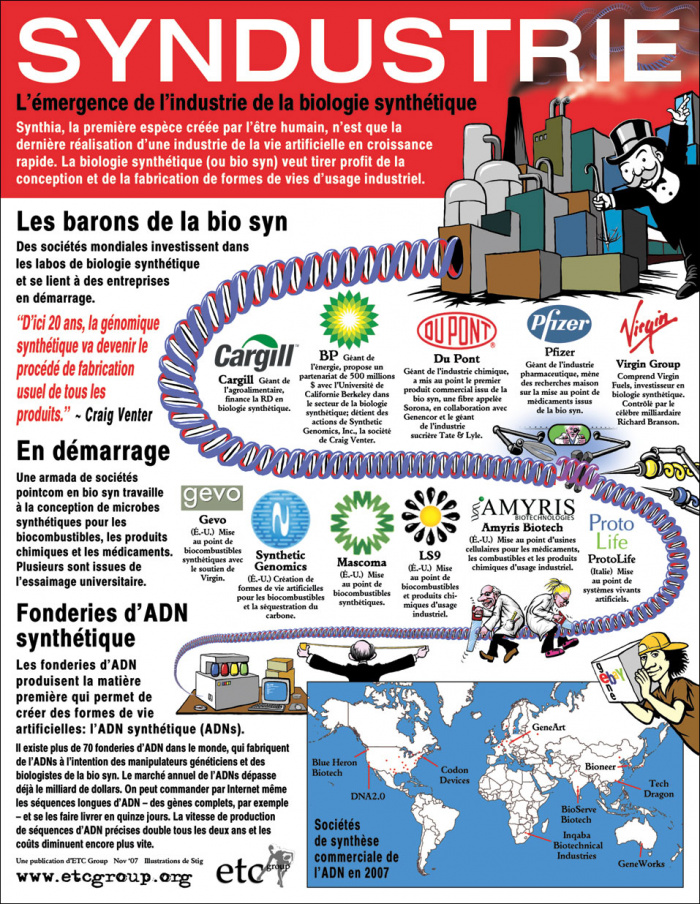
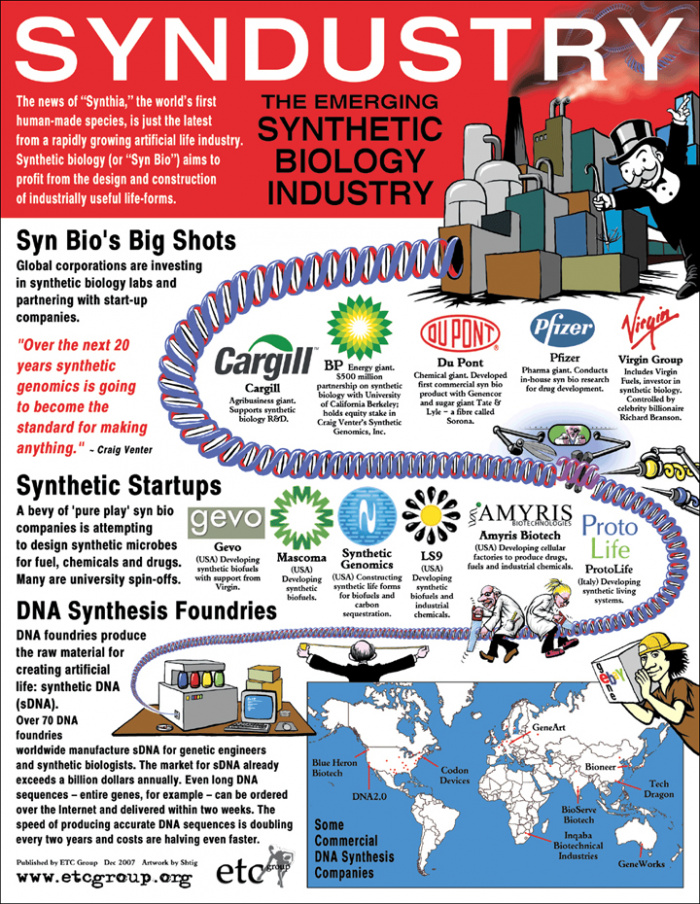
Syndustrie
Enviado por ETC Staff el

Enviado por ETC Staff el
Enviado por ETC Staff el
Enviado por ETC Staff el
Enviado por ETC Staff el
Enviado por ETC Staff el
Silvia Ribeiro*
Ante los rebrotes de la gripe porcina y la "amenaza" de nuevos contagios masivos en las estaciones frías que se aproximan en el hemisferio norte, varios gobiernos se aprestan a iniciar campañas de vacunación masiva, todas con gran drenaje de recursos públicos, que invariablemente beneficiarán al pequeño club de trasnacionales farmacéuticas que monopolizan las patentes y fabricación de vacunas a nivel global.
Enviado por ETC Group el

Enviado por ETC Staff el
Silvia Ribeiro*
La crisis climática se siente ya en todas partes: lluvias abundantes y fuera de temporada, mayores sequías y en lugares donde no las había, más inundaciones, fríos y calores extremos, huracanes más fuertes y en nuevas regiones, pérdida de cosechas, devastación de ecosistemas…
Ante esto, las empresas y gobiernos que han causado el cambio climático impulsan propuestas cada vez más peligrosas, como la geoingeniería o manipulación voluntaria del clima.
Enviado por ETC Staff el
Estando bajo la dirección del presidente de la Sociedad Real (Academia de Ciencias del Reino Unido), Lord Martin Rees, y comentado por James Lovelock, padre de la Hipótesis de Gaia, el reporte recién publicado de esta academia[1], que analiza las posibilidades de rediseñar el mundo por medio de la geoingeniería para salvarlo de la crisis del clima, podría parecer la encarnación personificada del principio precautorio.
Enviado por ETC Staff el
With the Royal Society’s President, Lord Martin Rees, presiding and James Lovelock, the father of the Gaia Hypothesis, commenting, the release of the Society’s report[1] outlining the possibilities for geoengineering the world out of the climate crisis could seem the very embodiment of the precautionary principle. In his 2004 book, Our Final Century, it was Lord Rees after all who warned us that technological hubris could obliterate a million lives through “bio error or bioterror” before 2020. He is a cautious man not disposed to put faith in technological silver bullets. Likewise, Dr. Lovelock has been outspoken in his alarm over the impending climate chaos – edging toward geoengineering, but equally perturbed by the “Kafkaesque” prospects of scientists and governments trying to rejig the planetary thermostat.
Enviado por ETC Staff el
The oldest scientific academy in the world, the UK’s Royal Society, will release its long-awaited report on geoengineering September 1st 2009 in London. The report, drafted by a panel dominated by geoengineering enthusiasts, is widely expected to recommend that the government support more research and perhaps even real-world experimentation of these controversial new technologies that intentionally manipulate the earth’s climate on a large scale with the aim of lessening the effects of climate change.
“Geoengineering is a bad idea, and, unfortunately, it may transform Lord Rees’s book from musings to memoir,” says Diana Bronson, researcher for the international technology watchdog ETC Group, referring to the Royal Society President’s 2004 book, Our Final Century, which suggested that humans may not live to see the end of the 21st century.
Enviado por ETC Staff el
La institución científica más antigua del mundo, la Sociedad Real del Reino Unido, publica hoy un muy esperado reporte sobre geoingeniería. Muchos prevén que el reporte, redactado por un panel dominado por entusiastas de la geoingeniería, recomendará que el gobierno apoye más investigaciones y quizá hasta experimentos en el mundo real con estas nuevas y polémicas tecnologías que intencionalmente manipulan el clima de la tierra en gran escala con el objetivo de disminuir los efectos del cambio climático.
Enviado por ETC Staff el
Siete trabajadoras chinas enfermaron gravemente luego de haber trabajado algunos meses en una fábrica de pinturas que usaba nanopartículas. Sufrieron daños severos y permanentes en los pulmones, erupciones en rostro y brazos. Dos de ellas murieron y las demás no mejoran después de varios años. El caso fue revelado en un artículo publicado en 20 de agosto 2009 en el European Respiratory Journal, escrito por investigadores chinos liderados por Yuguo Song, del Departamento de Enfermedades Laborales y Toxicología Clínica del Hospital Chaoyang de Beijing.
Enviado por ETC Staff el
La galerie contient toutes caricatures de RAFI et ETC Group.
Le droit d'auteur: Reymond Pagé ou Stig. Pour en savoir plus, lisez notre page Crédits.
VOLER CES CARICTURES! Merci de ne pas les modifier et de mentionner la source et l'auteur.
Cliquez sur une miniature pour afficher la version complet.
Enviado por ETC Group el
Enviado por ETC Group el
Communiqué et avis aux médias
If you are a journalist or organization that has interviewed a member of our staff and would like to add them to this page, please email the file and/or URL to joelle@etcgroup.org.
Enviado por ETC Staff el
Silvia Ribeiro *
Enviado por ETC Staff el
El 27 de julio pasado, el secretario de Agricultura, Alberto Cárdenas Jiménez, presentó otro componente de la farsa de bioseguridad en México: la Red Mexicana de Monitoreo de Organismos Genéticamente Modificados, otra forma de subsidiar con recursos públicos a las trasnacionales de los transgénicos.

Para saber más sobre el Grupo ETC o para contactarnos.