Recent content

¿Geoingeniería para arruinar los mares de las Islas Galápagos?

Abierto desafío al Panel sobre Cambio Climático de la ONU

Mientras el IPCC (Panel Intergubernamental sobre Cambio Climático) —principal grupo científico de la ONU en el tema— se prepara para criticar el concepto de la geoingeniería, Planktos Inc., una impertinente empresa de geoingeniería, anunció estar lista para descargar varias toneladas de partículas minúsculas en las aguas alrededor de las Islas Galápagos, cubriendo un área más grande que Puerto Rico. La empresa asegura que a partir de ello podrá rediseñar la atmósfera, ganar créditos comerciales de carbono e inclusive obtener el premio de $ 25 millones de dólares por la reducción de gases de invernadero, ofrecido por Richard Branson. Gran cantidad de científicos de primer nivel son escépticos en torno a la geoingeniería y muchos grupos ambientalistas y organizaciones civiles están protestando airadamente por lo que consideran una estupidez.

Patente de Monsanto sobre soya, cuestionada en Munich

La Oficina Europea de Patentes decidirá el futuro de la patente monopólica sobre frijol de soya el 3 de mayo de 2007

l 3 de mayo de 2007, el Grupo ETC (organización internacional de la sociedad civil con sede en Canadá, conocida anteriormente como RAFI) junto con “No Patents on Life!” y Greenpeace continuarán una batalla legal de 13 años contra una de las patentes de biotecnología más tristemente célebres. En una audiencia que tendrá lugar en la Oficina Europea de Patentes, en Munich, organizaciones de la sociedad civil argumentarán que la patente de Monsanto (EP No. 301-749) sobre todas las variedades de soya transgénica —sin precedentes por su rango tan amplio— debe revocarse. “Ninguna patente simboliza la falibilidad del sistema de patentes mejor que la de Monsanto que cubre toda una especie, los frijoles de soya diseñados genéticamente”, dijo Hope Shand de el Grupo ETC. “La patente de Monsanto tiene graves fallas técnicas y es inaceptable del punto de vista moral”, afirmó Shand.

Top Ten Seed Companies 2007

Top Ten Seed Companies 2007
Inglés

In a couple of days Hope Shand from ETC Group will be in court in the European patent Office to challenge Monsanto's Patent on Soy beans - a patent that we have been contesting for 13 years and that originally Monsanto themselves opposed!! You can read more about that here. In the meantime, ETC Group is releasing its new ranking of the world's top 10 seed companies, based on 2006 seed revenues. The list appears below.

Green Revolution 2.0 for Africa?

This time the “silver bullet” has a gun

Issue: Everybody’s trying to jump-start science – and, especially, agricultural science – in Africa. Starting with the G8 meeting in Canada five years ago – and pledges by four of its members to build new centers of scientific excellence in Africa – the Syngenta Foundation, CGIAR, Jeffrey Sachs’s Earth Institute, and now, Google, Gates, and Rockefeller are all pushing new initiatives for the continent. While there is no denying that Africans deserve support in their struggle to address hunger, disease and climate change, science and technology are no “silver bullet” to resolve Africa’s problems. Yet, when the G8 meets this June in Germany they are expected to announce a new research agenda that will again propose scientific solutions to the world’s – and, particularly Africa’s – social problems.

¿Revolución Verde 2.0 para África?

Parece que la “bala de plata” ya tiene un arma

Asunto: En África todo mundo quiere impulsar la ciencia, y especialmente la ciencia agrícola. A partir de la reunión del G8 hace cinco años en Canadá, donde cuatro de sus miembros prometieron construir nuevos centros de excelencia científica, ahora la Fundación Syngenta, el CGIAR, el Jeffrey Sachs Earth Institute, Google, Gates y Rockefeller, están impulsando nuevas iniciativas para el continente. Si bien nadie niega que los africanos necesitan ayuda en su lucha para acabar con el hambre, las enfermedades y el cambio climático, la ciencia y la tecnología no son la “bala de plata” para resolver los problemas de África. Sin embargo, en junio se reunirá el G8 en Alemania, donde se espera el anuncio de una nueva agenda de investigación que propondría, precisamente, soluciones científicas para los problemas sociales del mundo y especialmente de África.

Monsanto's Soybean Monopoly Challenged in Munich

European Patent Office Will Decide Fate of Species-Wide Soybean Patent on 3 May 2007

On 3 May 2007 ETC Group (a Canadian-based international civil society organization - formerly known as RAFI) together with "No Patents on Life!" and Greenpeace will continue a 13-year legal battle against one of biotech's most notorious patents. At an appeal hearing at the European Patent Office in Munich, civil society organizations will argue that Monsanto's patent (European Patent No. 301-749) on all genetically engineered soybeans - unprecedented in its broad scope - must be revoked. "No patent symbolizes the brokenness of the patent system better than Monsanto's species-wide patent on genetically engineered soybeans," said Hope Shand of ETC Group. "Monsanto's patent is both technically flawed and morally unacceptable," said Shand.

5-4-3-2-1! GM Crop Countdown.

5-4-3-2-1! GM Crop Countdown.
Inglés

The biotech industry claims that the global area devoted to GM crops in 2005 was 90 million hectares - or 222 million acres. ETC Group does not endorse or agree with the validity of annual statistics on GM crops compiled by the International Service for the Acquisition of Agri-biotech Applications (ISAAA).

We agree with civil society critics who charge that ISAAA's statistics are inflated and unreliable. However, even using industry-generated statistics, the biotech countdown is revealing. Here are the vital statistics:

News Release: Food Sovereignty or Green Revolution 2.0?

This time the “silver bullet” has a gun

ETC Group released a 16-page review of five new initiatives intended to launch what ETC dubs “Green Revolution 2.0” in Africa. Leading the charge is a plan to construct four Centers of Excellence together with a second initiative called the Alliance for a Green Revolution in Africa (AGRA), funded by the Bill and Melinda Gates Foundation and the Rockefeller Foundation. “The Green Revolution that followed World War II focused on semi-dwarf, high-yielding plant varieties” says Pat Mooney, ETC Group’s Executive Director. “It was a one-size-fits-all, take-it-or-leave-it silver bullet,” Mooney adds, “Africa left it.” In other words, Green Revolution technologies were inappropriate for the needs and resources of African farmers. ETC Group’s communiqué warns that, in Green Revolution 2.0, “big-box” science is being buttressed by a strategy to restructure African agriculture. Although the cornerstone of the new revolution will still be high-tech seeds, the G-8 and private foundations also want continental changes in market structure, intellectual property laws, and seed regulation so that agribusiness suppliers can profitably sell seeds, chemicals, and other inputs to farmers. “Big-box science will be linked to small box suppliers,” Mooney argues, “This time, the silver bullet has a gun.”

Civil Society/Labor Coalition Rejects Fundamentally Flawed Dupont-ED Proposed Nanotechnology Framework

Urges All Parties To Reject The Public Relations Campaign

To All Interested Parties:

We, the undersigned, submit this open letter to the international nanotechnology community at large. We are a coalition of public interest, non-profit and labor organizations that actively work on nanotechnology issues, including workplace safety, consumer health, environmental welfare, and broader societal impacts.

DuPont Chemical Company (DuPont) and Environmental Defense (ED) jointly have proposed a voluntary “risk assessment” framework for nanotechnology. These groups intend to circulate their proposed framework both in the U.S. and abroad for consideration and/or adoption by various relevant oversight organizations, including the U.S. Environmental Protection Agency (EPA).

2006 and the plutocracy

2006 and the plutocracy
Inglés

In this article the author makes a very enlightening summary of corporate concentration during 2006, and how this affects our lives as simple citizens even though we think its something happening far away by Silvia Ribeiro Corporate concentration through global mergers and acquisitions reached a record at the close of 2006.

Gambling with Gaia

With hopes for Kyoto dimming, some governments may conclude that massive earth restructuring is the only feasible way out

Issue: Kyoto is fading and carbon trading is a farce. Recognizing this, OECD states can either “bite the bullet” and adopt socially-responsible policies to dramatically cut fossil fuel use and useless consumption or, they can hope for a “silver bullet” – some new techno-fix that might let them have their cake and eat it too. The silver bullet may be winning. At the UN’s Intergovernmental Panel on Climate Change, the US government is lobbying for “geoengineering” activities such as deliberately polluting the stratosphere to deflect sunlight and lower temperatures. At least 9 national governments and the European Union have supported experiments to spread iron filings on the ocean surface to nurture plankton and sequester carbon dioxide. At least a dozen additional countries are involved in stratospheric weather/climate modification. Commercial carbon traders are engaging in ocean fertilization as well. The scientific debate and the government/commercial experimentation is taking place, once again, in the absence of public discussion.

Gambling with Gaia

ETC Group Warns that US Government’s Push for Geoengineering is Unacceptable

On the day before the United Nations Intergovernmental Panel on Climate Change (IPCC) sounds its loudest alarm yet, ETC Group warns that some OECD states, led by the United States, are betting on a pie-in-the-sky techno-fix to address climate change. “Geoengineering” refers to the intentional, large-scale manipulation of the environment to bring about environmental change. With no hope for Kyoto, little political will to ask industry or voters to change lifestyles and a growing recognition that carbon trading is a farce, some governments are concluding that massive earth restructuring is the only way out. The Guardian reported earlier this week that the US government is lobbying the IPCC to promote geoengineering activities, such as deliberately polluting the stratosphere to deflect sunlight and lower temperatures. (1)

Jugando con Gaia

Al ver cómo agoniza el Protocolo de Kioto, algunos gobiernos concluyen que una reestructuración planetaria es la única salida posible

Al tiempo que el Panel Internacional de Naciones Unidas sobre Cambio Climático (IPPC) hará pública su alarma más contundente hasta el momento, el Grupo ETC advierte que algunos países de la OCDE, encabezados por Estados Unidos, empujan por que se hagan solamente “arreglos técnicos” para enfrentar el cambio climático. El más extremo —la “geoingeniería”— se refiere a la manipulación intencional del ambiente a gran escala, para ocasionar cambios ambientales. Sin esperanzas de que funcione el Protocolo de Kioto, sin voluntad política para pedir a la industria y a los electores los necesarios cambios de producción y estilo de vida y sin poder negar las evidencias de que el comercio de emisiones de carbono es una farsa, algunos gobiernos empiezan a argumentar que la reestructuración masiva de la Tierra es la única salida. The Guardian reportó a principios de esta semana que el gobierno de Estados Unidos está cabildeando al IPCC para que promueva soluciones de geoingeniería, como contaminar deliberadamente la estratósfera para desviar la luz del sol y abatir las temperaturas.

Ganadores de la competencia para un logo de peligro nanotecnológico, anunciados en el Foro Social Mundial en Nairobi

Cientos de las 30 mil personas reunidas en el Foro Social Mundial celebrado esta semana en Nairobi, Kenya, votaron por su símbolo favorito para advertir contra el peligro nanotecnológico o los materiales diseñados con nanotecnologías (un nanómetro es inconcebiblemente pequeño: equivale a una mil millonésima parte de un metro).

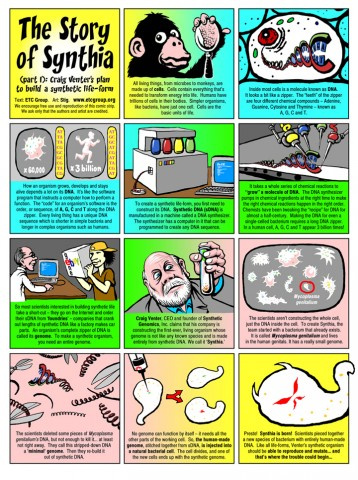
Ingeniería genética extrema: El Grupo ETC publica su informe sobre Biología Sintética

Un nuevo informe del Grupo ETC concluye que los riesgos sociales y ambientales de la biología sintética rebasan con mucho los peligros y abusos de la biotecnolgía. El texto, de 70 páginas, puede descargarse sin costo alguno en el sitio web del Grupo ETC.

“La ingeniería genética es cosa del pasado,” afirmó Pat Mooney, Director Ejecutivo del Grupo ETC. “Hoy, los científicos no solo mapean genomas y manipulan genes, sino que están construyendo la vida desde cero, y sin debate social alguno o siguiendo normas de ningún tipo, afirmó Mooney.

Extreme Genetic Engineering: An Introduction to Synthetic Biology

ETC Group Releases Report on Synthetic Biology

A new report by the ETC Group concludes that the social, environmental and bio-weapons threats of synthetic biology surpass the possible dangers and abuses of biotech. The full text of the 70-page report, Extreme Genetic Engineering: An Introduction to Synthetic Biology, is available for downloading free-of-charge on the ETC Group website.

"Genetic engineering is passé," said Pat Mooney, Executive Director of ETC Group. "Today, scientists aren't just mapping genomes and manipulating genes, they're building life from scratch - and they're doing it in the absence of societal debate and regulatory oversight," said Mooney.

Páginas

Suscribirse a Recent content