Recent content

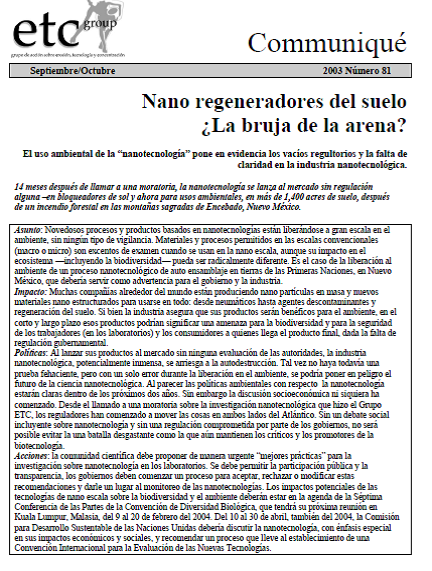
Nano regeneradores del suelo. La bruja de la arena

El uso ambiental de la “nanotecnología” pone en evidencia los vacíos regultorios y la falta de claridad en la industria nanotecnológica

14 meses después de llamar a una moratoria, la nanotecnología se lanza al mercado sin regulación alguna -en bloqueadores de sol y ahora para usos ambientales, en más de 1,400 acres de suelo, después de un incendio forestal en las montañas sagradas de Encebado, Nuevo México.

La contaminación transgénica del maíz campesino en México

Documento colectivo de comunidades indígenas y campesinas de Oaxaca, Puebla, Chihuahua, Veracruz, CECCAM, CENAMI, Grupo ETC, CASIFOP, UNOSJO y AJAGI

A más de dos años de que se conoce que existe contaminación transgénica del maíz campesino en México, centro de origen del cultivo, el gobierno mexicano, no ha hecho nada constructivo para enfrentar el tema, ni para establecer responsabilidades, ni para par

Alimentando el mundo a la fuerza

Trece millones de personas en Lesotho, Malawi, Swazilandia, Zambia, Zimbabwe y Mozambique están amenazadas de hambruna, debido a la sequía extrema, epidemias y "mala administración política", según la FAO. Hubiera sido apenas una noticia más -pese a ser terrible-, de no ser porque varios países se negaron a recibir la ayuda alimentaria del Programa Mundial de Alimentos (PMA) por contener maíz transgénico. Esto desató un virulento debate internacional. Estados Unidos y su agencia para el desarrollo (USAID) censuraron duramente a estas naciones, que según Colin Powell, en su discurso ante la cumbre de Desarrollo Sostenible en Sudáfrica, "condenan a sus poblaciones al hambre" al no aceptar transgénicos.

¡NANOTECNOLOGIA SIN PLAGA!

El barullo en torno la plaga gris/verde puede convertirse en la segunda metida de pata de la industria

La amenaza de la Plaga Gris (robots nanoescalares reproduciéndose incontrolablemente) se ha convertido en el lobo feroz que nunca llega, frecuentemente desacreditada por la industria y los científicos como una imposibilidad técnica. De manera irresponsable se están ignorando los peligros reales que presentan las nanotecnologías, incluyendo la toxicidad potencial de las nanopartículas y las implicaciones de largo alcance de la nanobiotecnología.

Nanotech Un-gooed!

Is the Grey/Green Goo Brouhaha the Industry's Second Blunder?

The threat of Grey Goo (nanoscale mechanical robots reproducing uncontrollably) has become the itsty-bitsy boogey man, handily dismissed by industry and Nobel laureates as a technical impossibility. But they are ignoring the very real and present dangers that nanotechnologies pose, including the potential toxicity of nanoparticles and the farther-reaching implications of nanobiotechnology.

Tecnología Terminator - Cinco años después

Syngenta obtiene nueva patente Terminator

La Federación Internacional de Semillas del Departamento de Agricultura de Estados Unidos alaba los beneficios de las semillas Terminator.

Terminator representa "considerables riesgos para la sociedad": UPOV

Nueva "Tecnología Exorcista" intenta acallar las protestas públicas contra los transgénicos

Terminator Five Years Later

New Developments: While claiming not to have reversed their position against commercialization of Terminator seeds, some Gene Giants are continuing to seek new patents on genetic seed sterilization and others are boldly advocating in favor of GURTs (genetic use restriction technology) in intergovernmental negotiations. Stung by negative publicity related to the escape of DNA from genetically modified (GM) plants, industry continues to "greenwash" Terminator by promoting it as a biosafety tool for containing unwanted geneflow from GM plants. Biotech company Maxygen has unveiled a new technology designed to banish foreign DNA from GM plants as a way to silence critics of genetic engineering. ETC Group calls it the "Exorcist" technology.

La technologie Terminator, cinq ans plus tard

Depuis le mois de mars 1998, ETC Group (anciennement RAFI) surveille les travaux des multinationales de l'agrochimie et des semences visant à développer les semences Terminator - des plantes généticement manipulées pour que leur graines deviennent stériles (ce qui signifie que la seconde génération de semences ne germera pas).

La nanotecnología y el Príncipe Precautorio

Las preocupaciones del Príncipe Carlos de Inglaterra en torno a la revolución emergente de la nanotecnología (que el Grupo ETC prefiere nombrar tecnología atómica), llegaron a los encabezados de los tabloides con el tema de la "plaga gris"( los nanorrobots autoreplicantes fuera de control y el apocalipsis inminente), tomando primeras planas en varios diarios del mundo. Sin embargo, estos virulentos ataques contra el Príncipe tal vez sean los los útimos de una serie de erorres técnicos y tácticos que los ambiciosos promotores de la nanotecnología están cometiendo.

Nanotech and the Precautionary Prince

Prince Charles' concerns about the emerging revolution in nanotechnology have catapulted tabloid headlines about "grey goo" (and impending doom) onto front pages around the world. Industry fears that the great GMO (genetically modified organisms) debate is about to go down to the nanoscale inhabited by atoms and molecules. But the virulent attacks against the Prince may only be the latest of a series of technical and tactical mistakes made by nanotech's over-eager proponents.

Monsanto's Species-Wide Patent on Trial

May 6-7 2003, European Patent Office Hears Patent Challenge in Munich - Eight and One-Half Years Later!

Remember 1994? Nine years ago: Yasser Arafat, Yitzhak Rabin, and Shimon Peres won the Nobel Peace Prize, Nelson Mandela was elected President of South Africa, US President Bill Clinton sent ground troops to the Persian Gulf to counter a move by Iraq's Saddam Hussein, and Brazil won the World Cup. The United Nations' Biodiversity Convention entered into force in 1994 and the Uruguay Round of GATT was drawing to a close. In the "life sciences" cosmos, Monsanto and Dupont were chemical companies with minor interests in seeds and Syngenta did not yet exist. ETC Group was known as RAFI. Also in 1994, a small biotech subsidiary of W.R. Grace, Agracetus, won a breathtakingly broad patent on all genetically modified soybean varieties, European Patent No. 301,749.

Broken Promise? Monsanto Promotes Terminator Seed Technology

At its annual meeting on Thursday, April 24th 2003, Monsanto's top brass will greet shareholders with a dismal financial report, (a 15% drop in annual sales - $4.7 billion in 2002, down from $5.5 billion in 2001) and a shareholder resolution that urges the company to re-think the safety of genetically engineered seeds - now the company's flagship product. But there's potentially more troubling news - a little known position paper that could rattle shareholders, irk investors and erode public confidence still further in the biotech behemoth: Despite its 1999 pledge not to commercialize Terminator technology, Monsanto has recently adopted a positive stance on genetic seed sterilization, a technology that has been condemned by civil society and some governments as an immoral application of genetic engineering.

Who Calls the Shots at UPOV?

US Government and Multinational Seed Industry Force UPOV to Abandon Critique of Terminator

After two days of intense diplomatic wrangling in Geneva, April 10-11 2003, US patent officials succeeded in turning the expert advice of an intergovernmental secretariat critical of Terminator technology into little more than a promotional paper for plant breeders' rights.

UPOV has succumbed to the strong-arm tactics of the US government and the multinational seed industry, both of whom have vested financial interests in Terminator technology. If member governments of UPOV had any doubts about who determines policy within the Union, they need only examine the recent case of Terminator.

El tamaño sí importa

Nueva información provee mayor evidencia para implementar una moratoria sobre las nano partículas sintéticas: Grupo ETC

Nueva evidencia de los riesgos de las nano partículas El Grupo ETC publicó el 14 de abril 2003 un nuevo documento de la serie Occasional Papers, con el título "Size Matters! No small matter II: The Case for a Global Moratorioum." El informe llama a los gobiernos a adoptar una moratoria sobre los nano materiales sintéticos que se están fabricando en los laboratorios y en algunos casos ya se están comercializando, ante la ausencia de pruebas sobre su inocuidad para la salud, la seguridad y sus impactos ambientales.

Páginas

Suscribirse a Recent content