Recent content

En busca de un terreno más alto

El desafío de la propiedad intelectual a la investigación agrícola pública y a los derechos humanos. 28 Propuestas alternativas

Dado el actual desequilibrio en su gobierno, (predominancia de representantes hombres blancos anglófonos de países del Norte) el CGIAR (Grupo Consultivo de Investigación Agrícola Internacional) no tiene ni la competencia ni los mecanismos para rendir cuentas al público para tomar decisiones sobre la aplicación de propiedad intelectual o la relación entre el sector público y privado en investigación. Inmersos en su trabajo y en la lucha por sobrevivir, han tomado el camino que ofrecía menos resistencia y están proponiendo entrar en sistemas de propiedad intelectual y patentes.

Volume 6, #1, In Search of Higher Ground

The Intellectual Property Challenge to Public Agricultural Research and Human Rights and 28 Alternative Initiatives

Given their current governance structure, CGIAR has neither the competence nor the accountability to be entrusted with intellectual property (IP) or public/private policy decisions. Immersed in their work and the struggle to survive, they have taken the path of least resistance and followed the IP trail. RAFI suggests at least 28 specific policy initiatives that the public sector should consider as alternatives to IP. A 33 page document.

Presos y arados

Quién va a alimentar los presos?

Según el Justice Policy Institute de Washington la población carcelaria de Estados Unidos superó recientemente los dos millones.* Las estadísticas son impresionantes, especialmente considerando que Estados Unidos tiene un cuarto de los presos de todo el mundo, pero sólo el 5% de la población mundial.

The Mouse that Roared on Animal Pharm

Canadian Courts Rule that Mammals can be a Patented Invention

In a split 2-1 decision, the Canadian Federal Court of Appeal ruled in favour of granting a patent to Harvard Medical School for the oncomouse, a mouse genetically engineered to carry a cancer-causing gene. The decision marks another point in the 15-year battle in the Canadian courts over whether Mother Nature or a Harvard scientist invented the mouse and its offspring.

Condenadas a la extinción?

SEMINIS elimina 2000 variedades

Seminis, la empresa más grande del mundo en semillas de hortalizas, anunció pasado que, para reducir costos, eliminará 2000 variedades (aproximadamente el 25% del total de su línea de productos en este rubro). Las fusiones empresariales de las compañías semilleras están resultando en una disminución dramática de la disponibilidad de semillas no híbridas y de variedades de hortalizas, perdiendo así una enorme riqueza de diversidad de semillas en forma irreparable.

USDA Refuses to Abandon Terminator Technology

Delta & Pine Land Gets One Step Closer to Commercialization

Two days of contentious debate on Terminator has ruptured the US Department of Agriculture's (USDA) Advisory Board on Agricultural Biotechnology. Terminator technology, the genetic engineering of plants to produce sterile seeds, has been widely condemned as a dangerous and morally offensive application of agricultural biotechnology, because over 1.4 billion people depend on farm-saved seeds.

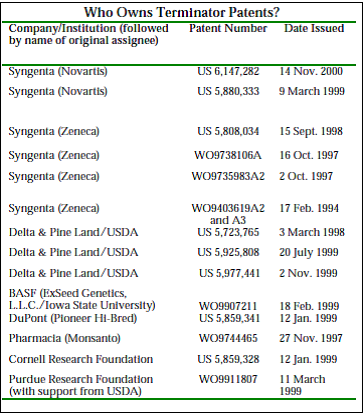
USDA ignited the worldwide controversy in March 1998 when it won the first of three patents on genetic seed sterilization, which it holds jointly with Delta & Pine Land - the world's largest cotton seed company.

Snakes in the GM Grass

Scotts Says GM Grass Could be Greener with Terminator. USDA's Biotech Advisory Board Ruminates on Terminator.

GM (genetically modified) crops may be a fiasco on the farm, but Monsanto and its partner Scotts (Ohio, USA), are hoping that GM grass will be a sensation in suburbia. A page-one story in the New York Times, July 9th, reports that Scotts Company in collaboration with Monsanto and Rutgers University is developing genetically modified grass for suburban lawns and golf courses (David Barboza, 'Ground-Level Genetics, for the Perfect Lawn,' New York Times, July 9, 2000, p. 1.). Scotts predicts that the market for GM grass could sprout to a whopping $10 billion. (By contrast, the entire commercial market for crop seeds in the US is worth approximately $5 billion per annum.) Monsanto and Scotts are developing herbicide tolerant strains that can withstand spraying of Monsanto's blockbuster weedkiller Roundup, as well as genetically altered, slow-growing ('mow-me-less') grass. Just around the dogleg, Scotts and Monsanto foresee GM grass in designer colours.

Earmarked for Extinction?

Seminis Eliminates 2,000 Varieties

Seminis, the world s largest vegetable seed corporation, announced that it would eliminate 2,000 varieties or 25% of its total product line as a cost-cutting measure. Seed industry consolidation is dramatically narrowing the availability of non-hybrid vegetable varieties and a wealth of seed diversity is being lost forever.

Despite Mounting Opposition from Southern nations, delegates at the Biodiversity Convention fail to ban Terminator

In the face of mounting evidence of its commercialization, the Fifth Conference of the Parties (COP 5) to the Biodiversity Convention (CBD) failed to heed the warnings of most of the world's nations to ban the Terminator technology. 'By not responding to the calls made by many of the nations of the world, a minority of COP delegates from the North ultimately abdicated their responsibility to international food security and biodiversty,' said Julie Delahanty of RAFI.

Despite information about new patents and field trials, and the strong opposition to Terminator and genetic use restriction technologies (GURTs)* expressed clearly by most of the world's nations, the CBD approved a proposal coming from its Scientific Advisory Body (called SBSTTA). That proposal recommends that GURTs not be approved for field-testing or be commercialized until more scientific data can be gathered on its potential impacts. The text also states that Parties may choose to establish a complete moratorium on these technologies at the national level.

Biopiracy - RAFI's Sixth Annual Update

Captain Hook, the Cattle Rustlers, and the Plant Privateers: Biopiracy of Marine, Plant, and Livestock Continues

Biopiracies are on the increase and governments are doing nothing useful about it. These cases demonstrate the power of exclusive monopoly patents to disrupt and distort domestic and international markets for Southern farmers, and to appropriate the innovative genius of indigenous peoples and rural societies.

Biopiratería. Sexto Informe Anual de RAFI

El Capitán Garfio, los ladrones de ganado y los corsarios de plantas: continúa la biopiratería de especies marinas y terrestres, vegetales y animales

Cada vez hay más biopiratas y los gobiernos no hacen nada que pueda impedirlo. Los casos en este Communique demuestran el poder que tienen los monopolios de patentes para destruir los mercados domésticos e internacionales de los agricultores del Sur, y para apropiarse del genio innovador de los pueblos indígenas y las sociedades rurales.

El documento completo está disponible en versión PDF (versión inglesa).

Terminator en el campo

El Convenio de Biodiversidad debe prohibir el uso de la tecnología Terminator, o el "Principio de Precaución" será un principio póstumo

Durante 1999 se otorgaron siete patentes nuevas sobre Terminator y más de una prueba de campo de tecnologías de restricción del uso genético (TRUGs). Los gobiernos presentes en la 5a. Conferencia de las Partes del Convenio sobre Diversidad Biológica (COP 5) deben actuar enérgicamente para prohibir Terminator y abrir una moratoria a las pruebas de campo o venta comercial de organismos modificados genéticamente con tecnologías de restricción del uso genético. "Esto será una prueba del tan voceado Principio de Precaución y del Protocolo de Bioseguridad negociado en enero pasado," advierte Silvia Ribeiro, "Si la COP 5 no logra ponerse de acuerdo en la prohibición de Terminator , que es un amenaza grave a la biodiversidad, mostrará que no se puede confiar en el Convenio y la ratificación del Protocolo será solamente una formalidad"

Terminator on Trial

Nairobi Biodiversity Meeting Must Ban Terminator Or Precautionary Principle Will Become Post-Mortem Critics Warn

1999 saw at least seven new Terminator patents, and more than one field trial of genetic use restriction technologies (GURTs). Governments meeting at COP5 in Nairobi (15-26 May) must act decisively to ban Terminator and call for a moratorium on field testing and commercial sale of GURTs. 'This is the litmus test for the CBD s much-touted precautionary principle and the Biosafety Protocol negotiated last January,' Silvia Ribeiro of RAFI warns, 'If the Convention can't agree on an all-out ban of the Terminator as a blatant threat to biodiversity, then it can't be trusted and the Protocol shouldn't be ratified.'

The Spill out from CIMMYT's Revised Patent Policy

Oil on Troubled Waters...or just a Tempest in a Test-tube?

In 1980 the U.S. Supreme Court narrowly voted to allow the patenting of a living microorganism intended to soak up oil spills.  The decision ushered in a new era in intellectual property.  Suddenly, the products and processes – even the formulae - of life became patentable.  From microorganisms, patent offices have soldiered on to grant exclusive monopolies for plants, animals, entire species, human cell lines, and even fragments of human DNA that only Computers have seen and no one has understood. 

USDA Betrays Public Trust with Two New Terminator Patents

Will USDA's Biotech Advisory Board Demand Accountability?

The Rural Advancement Foaundation International (RAFI), an international civil society organization based in Canada, announced today that the US Department of Agriculture (USDA) holds two new patents on the controversial Terminator technology, the genetic engineering of plants to render their seeds sterile. If commercialized, Terminator would make it impossible for farmers to save seeds from their harvest, forcing them to return to the commercial seed market every year.

Páginas

Suscribirse a Recent content