Submitted by Lucy Patterson on
Machakos County, Kenya
September 2026
Kenya has positioned itself as a leading hub for digital agriculture in Africa. Its robust connectivity, vibrant technology sector, widely known as the “Silicon Savannah”, and near-universal mobile money adoption have made it a testing ground for agricultural apps, digital credit, AI-assisted crop diagnostics, and national digital farmer registries. Yet the communities expected to benefit from these technologies are rarely asked whether they work, who they serve, or what they cost.
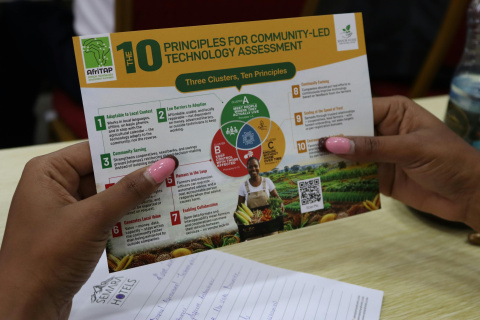
This report presents the findings of a participatory Technology Assessment conducted in Machakos County that brought together smallholder farmers, Community-Based Organisation (CBO) representatives, and officers of the Machakos County Government to examine how digital and agricultural technologies are reshaping farming livelihoods, knowledge systems, and rights, and to co-develop criteria communities can use to judge new technologies for themselves.
The national context is one of rapid digital growth. According to the KNBS Economic Survey 2026, ICT sector output grew by 3.8 percent to Ksh 728.2 billion in 2025, and mobile money subscriptions rose by 21.4 percent to 51.4 million. In 2025, Kenya launched its Artificial Intelligence Strategy 2025–2030, aiming to become Africa’s leading hub for AI development, with commitments to ethical deployment, cybersecurity, data sovereignty, and the inclusion of marginalised communities. The assessment found that these commitments have yet to reach the farm gate in Machakos, where digital tools are delivering real benefits alongside serious and largely unregulated harms.
Taken together, the findings show that digital agricultural technologies in Machakos County are delivering access to information and markets while simultaneously transferring risk, data, knowledge, and value away from farming households. The burden falls heaviest on women, who do most digital research and farm labour but control few decisions or finances, and on older farmers excluded by language and literacy. Kenya’s policy architecture, including the Data Protection Act 2019, the regulation of digital credit providers, the Protection of Traditional Knowledge and Cultural Expressions Act 2016, and the National AI Strategy, provides a foundation that remains poorly understood and weakly enforced at ward level.
This report makes specific recommendations to national and county government, civil society, and communities. Central among them are: closing the vetting loophole for agritech and lenders; a county agricultural data protection framework with farmer-friendly consent; enforcement against abusive digital lending practices; institutionalising community-led technology assessment in the county’s planning and budgeting cycle; legal safeguards for contract farming and research; protection of traditional knowledge through community registers; and gender- and youth-responsive digital inclusion.
“Tutoe hii masomo kwa hoteli tukuje kwa wakulima” — "Take this learning out of the hotels and bring it to the farmers." Communities in Machakos have the knowledge and innovation to shape technology around their needs; what they require is institutional support that meets them where they live and farm.
| Attachment | Size |
|---|---|
 machakos_technology_assessment_report_2026.pdf | 996.89 KB |