
Submitted by Ronnie Hall on
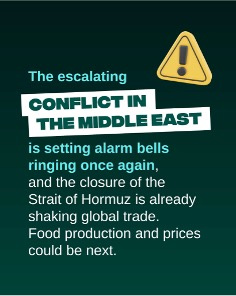
According to experts from ETC Group (Action Group on Erosion, Technology and Concentration), the commercial food model is so vulnerable that this blockage could drive up food prices, leading to a global food crisis. Researchers are therefore issuing an urgent call to strengthen local food systems based on food sovereignty and agroecology.
The global agro-industrial production model relies heavily on synthetic fertilizers and fossil fuels. Against the backdrop of the current armed conflict in the Middle East, a blockade of the Strait of Hormuz could cut off access to these resources, leading to rising food prices. According to United Nations Trade and Development (UNCTAD), one third of global fertilizer trade transported by sea (around 16 million tonnes) passes through this strait, as does a quarter of seaborne oil trade. Experts from ETC Group have warned that the situation is critical and could spiral into a new global food crisis, due to the increasing concentration of corporate control over global food production highlighted in their research.
“This crisis once again highlights the fragility of the dominant agro-industrial model. A food system based on monocultures, synthetic fertilizers, fossil fuels and long supply chains controlled by a handful of large corporations is acutely vulnerable to geopolitical instability and global trade shocks”, said Marcos Filardi, a researcher at ETC Group.
A recent UNCTAD analysis, entitled Strait of Hormuz Disruptions – Implications for Global Trade and Development, warns that disruptions to shipping traffic in the Strait of Hormuz, one of the world’s most important trade corridors, are already driving up the cost of transport, fuel and insurance for ships. These cost increases affect global supply chains and can have a rapid domino impact on agricultural production and food prices.
Fertilizers such as ammonia, phosphates and sulphur are largely sourced from Gulf countries. Almost half of the world’s urea, the most widely used nitrogen fertilizer, is produced in the region. Any disruption to this route raises alarm bells over the availability of fertilizers, and impacts on agricultural production.
A report by ETC Group and GRAIN highlights that synthetic fertilizers are produced from raw materials that are traded globally. This means that their cost is closely linked to the price of fossil fuels. Such dependence makes the agricultural system particularly vulnerable to price fluctuations and disruptions in international trade. Just ten corporations control around 39 per cent of the global fertilizer market, a business worth around 196 billion dollars.
Rising oil prices also have a direct impact on food costs. According to the IPES-Food report ‘Fuel to Fork’, fossil fuels are present in virtually every link of the food chain, from the production of fertilizers and pesticides to transport, plastic packaging, ultra-processed foods and temperature-controlled supply chains. Today, food systems consume around 40 per cent of all petrochemicals and around 15 per cent of fossil fuels globally.
Researchers from ETC Group stated: “In the face of this fragility, there is an urgent need to strengthen local food systems based on food sovereignty and agroecology, which reduce dependence on long distance supply chains and volatile global markets, and create fairer, more stable forms of food production and supply.”
Statistics recap:
- ⅓ of synthetic fertilizers (16 million tonnes) pass through the Hormuz Strait
- ¼ of seaborne oil trade also travels through the shipping channel
- Almost ½ of the world’s urea (the most widely used nitrogen fertilizer) is produced in the region
- 39% of the global fertilizer market is controlled by just 10 corporations
- 40% of all petrochemicals go into food systems
- 15% of fossil fuels are used for food production and supply
ETC Group Reports:
- Grain Traders, Greed and Oligopoly Power
- Top 10 agribusiness giants: Corporate concentration in food & farming in 2025
- Food Barons
Press Contact: Ronnie Hall, comms@etcgroup.org
| Attachment | Size |
|---|---|
 press_release_hormuz_strait_food_systems_-_etc_group.pdf press_release_hormuz_strait_food_systems_-_etc_group.pdf | 306.71 KB |