
Submitted by Ronnie Hall on
The full report can be downloaded below.
Spanish and summary versions will be available soon.
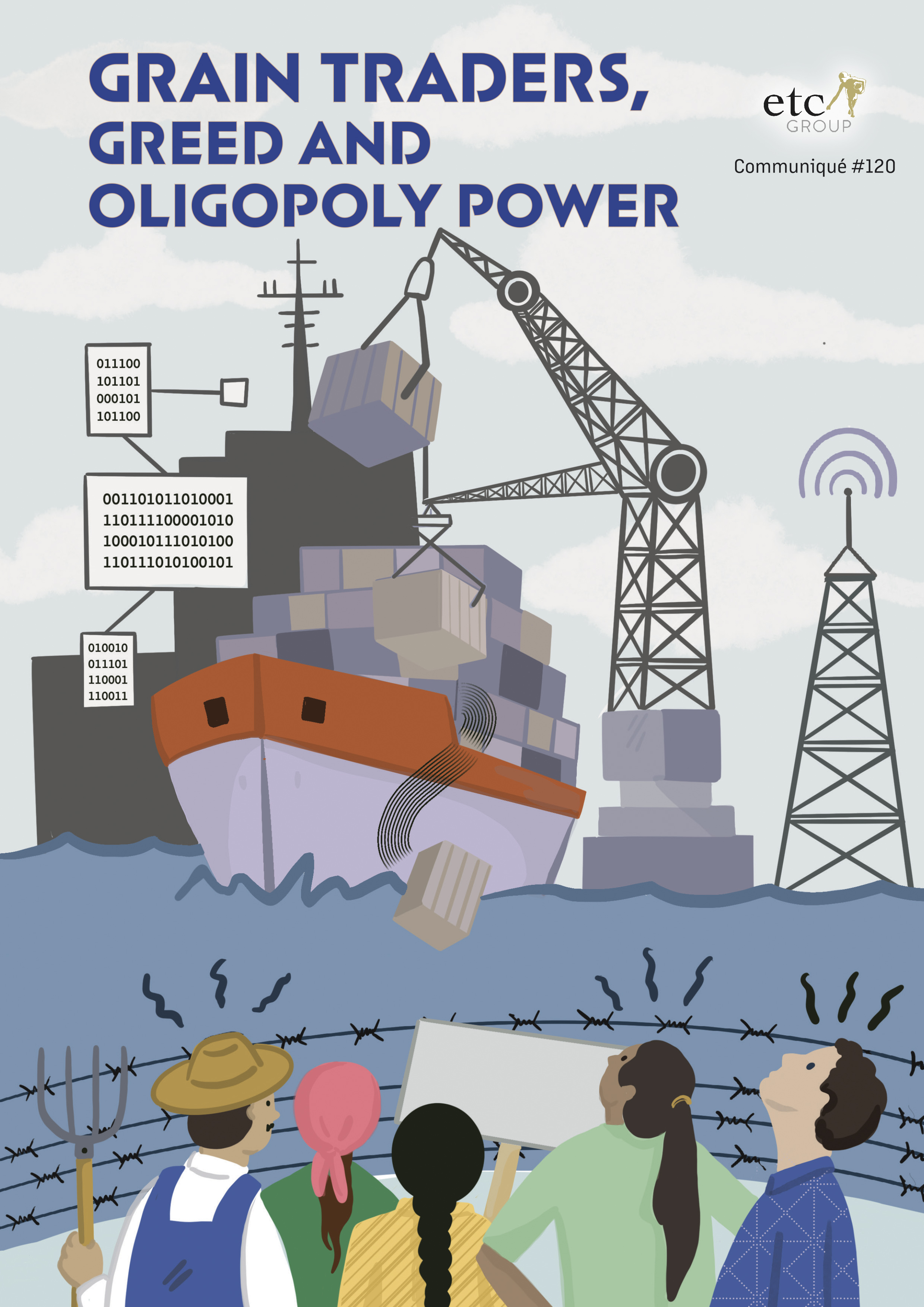
Front cover Illustration: @andre_m_medina
---
Agricultural Commodity Traders are complex, highly diversified global firms that operate in all phases of industrial food production and trade, from origination and storage to processing, marketing, financing and investment, and risk management.
Our new research confirms that they are among the most powerful and least transparent companies in the industrial food chain, influencing how, where and when a staggering volume of commercially traded food is grown, who grows it and under what conditions it is made available.
They occupy a central and expanding position in the industrial food chain. A handful of firms – Cargill, ADM, Bunge, Louis Dreyfus Company (LDC) and COFCO – control an estimated 70-80% of globally traded commercial grains and oilseeds. Agricultural Commodity Traders use their oligopoly market power and unregulated financial activities to profit from (and even contribute to) market volatility.
They have been reaping dividends from the deepening food crisis and supply chain disruptions, all of which threaten global food security. In 2023, the world’s 8 leading ag commodity traders piled up US$730 billion in 2023 revenues, close to the value of all Canada’s exports that year. The US$8.2 billion mega-merger of Bunge and Viterra finalized in July 2025 created the world’s third largest commodity trading behemoth (based on 2023 pro forma revenues). Their ability to operate simultaneously in physical commodity markets and financial derivatives allows them to convert volatility into a reliable profit engine.
At the same time state-owned actors are pursuing preferential ability to protect their food security and geopolitical advantage by buying equity stakes in giant commodity trading firms. A state-owned firm in the United Arab Emirates acquired a 45% stake in Louis Dreyfus in 2020. A state-owned entity in Saudi Arabia announced in early 2025 that it will buy a controlling stake (80%) in Olam Agri. The entry of sovereign wealth-backed actors further entangles commercial concentration with geopolitical leverage.
The industrial food chain is extremely vulnerable. This was evident in 2024 when commodity traders experienced maritime supply chain bottlenecks affecting three major shipping routes, because of a severe, prolonged drought in Central America depleting water levels and choking transit in the Panama Canal; attacks by Houthi rebels on vessels crossing the Red Sea causing gridlock in the Suez Canal; and the war in Ukraine continuing to snarl major grain shipment routes in the Black Sea. These chokepoints demonstrated how a system dominated by a few traders magnifies systemic risk, allowing firms with undisclosed inventories and privileged information to benefit from crisis conditions.
The profiteering power and market dominance of the ag traders is enhanced by their complex corporate structures (the top five commodity traders collectively operate a total of 3,310 subsidiary companies) and the secrecy of their operations. In the absence of regulatory oversight, they have transformed themselves into ‘shadow financial institutions’ according to the U.N. Centre for Trade and Development.
The combined grain storage capacity of just three grain traders – ADM, Bunge and COFCO – is comparable to the combined annual wheat consumption of the USA, UK and Turkey.16 Commodity traders aren’t obliged to disclose how much inventory they hold, what it is or where it is located. ‘Speculative storage behavior’ means that, even amid a global food crisis, ag traders have the potential to stockpile and withhold grain, awaiting higher prices. The discretionary control over stocks, prices and information gives them the ability to shape market dynamics.
Digital control is now as strategic as physical control of grain. Commodity traders command proprietary datasets that track crops, land use and logistics with granular precision. Using AI-driven analytics and blockchain platforms like Covantis, they monitor supply chains in real time and anticipate market shifts long before competitors or regulators. This exclusive commercial intelligence – inaccessible to governments or multilateral bodies – gives traders a decisive advantage to shape markets while remaining largely outside public scrutiny.
Regenerative agriculture and carbon-farming schemes have become key tools in traders’ climate-savvy rebranding. Framed as decarbonisation efforts, these market-based programmes enable companies to profit from carbon trading while expanding their capture of farm-level and geo-spatial data through proprietary digital platforms – with little evidence that they deliver real emissions cuts.
The grain traders’ unchecked, oligopoly power requires profound structural changes across food systems. Governments must crack down on commodity speculation and profiteering and close the loopholes that allow giant commodity traders to act as shadow financial institutions, including by excluding corporations with vested interests in agriculture and food from policy and governance negotiations on food and , and by requiring grain traders to disclose the location and inventories of grain reserves, as well as the movement of internationally-traded food commodities.
It is imperative to dismantle corporate power by diversifying, decentralizing and democratizing food production and trading systems, including fortifying and shortening the links between producers and consumers at the local and regional levels (i.e., by strengthening territorial markets). Food governance must be rooted in Food Sovereignty, where local food system actors hold decision-making power.
| Attachment | Size |
|---|---|
 grain_traders-20jan-final-v2.pdf grain_traders-20jan-final-v2.pdf | 6.61 MB |