ARIA: The UK's dubious 'deep tech' agency
Submitted by Ronnie Hall on
Submitted by Laura Dunn on
MINNEAPOLIS—Today, leading environmental and human health advocacy groups from the United States and Canada provided detailed evidence about face masks containing potentially toxic nanoscale materials in a letter to the Environmental Protection Agency (EPA), the Food and Drug Administration (FDA) and the Consumer Products Safety Commission (CPSC).
Submitted by Laura Dunn on
Brussels — Today, leading international health and environmental groups released a letter to European leaders urging immediate action to ban the sale and use of face masks and other personal protective equipment containing nanographene and other nanoparticles.
Submitted by Joëlle Deschambault on
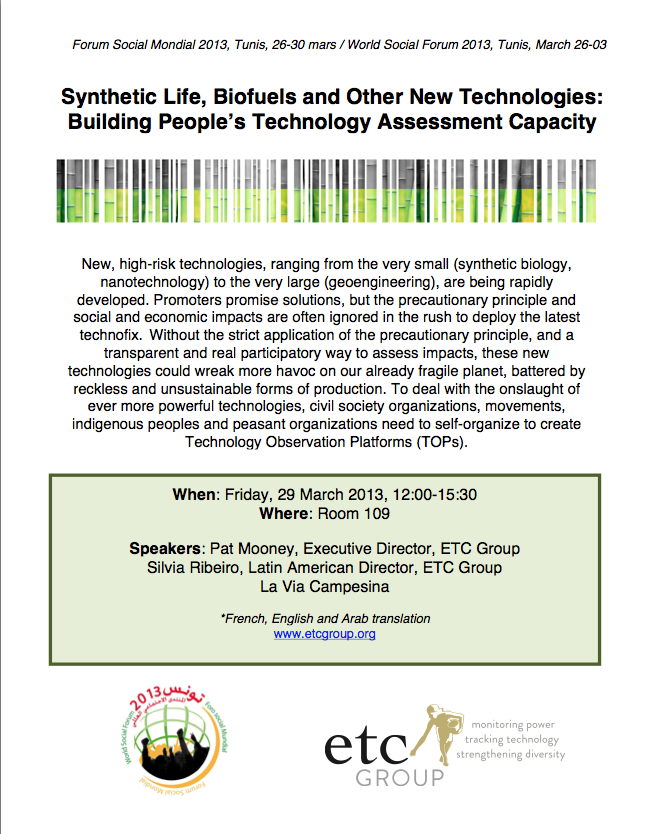
New, high-risk technologies, ranging from the very small (synthetic biology, nanotechnology) to the very large (geoengineering), are being rapidly developed. Promoters promise solutions, but the precautionary principle and social and economic impacts are often ignored in the rush to deploy the latest technofix. Without the strict application of the precautionary principle, and a transparent and real participatory way to assess impacts, these new technologies could wreak more havoc on our already fragile planet, battered by reckless and unsustainable forms of production. To deal with the onslaught of ever more powerful technologies, civil society organizations, movements, indigenous peoples and peasant organizations need to self-organize to create Technology Observation Platforms (TOPs).
Submitted by ETC Staff on
It's not just that we are facing "something new", we are facing "something else". The speed, breadth and depth of technological change is out-pacing and out-scoping policymakers. Since 1992, the convergence of technologies (living and inert) at the atomic - or nano - scale is adding new dimensions to the nature of technological transformation. Governments need global tools to respond to "something else". Find in this briefing ten technology leaps making the case for prioritizing Technology Assessment at the UN.
Submitted by ETC Staff on
Clean green technologies are at the center of the many special reports leading to Rio+20. Understandably, governments have focused on access to “know-how.” Since 1992, however, costly, resource-wasting experience has taught that “know-how” must be accompanied with “know-what” – assessment of the technology choices available – and “know-why” – a participatory analysis of socioeconomic and environmental needs a technology is to address.
Submitted by ETC Staff on
An efficient, transparent pathway for technological advancement would save national governments time and money while reducing risk. Those proposing new technologies and their backers seek to minimize risk. Especially, re-insurers and investors welcome steps that make government intervention and/or public responses predictable.
It is said that no one can predict the past but had the UN maintained its monitoring capacity over the last two decades – and had civil society been vigilant – the world might have saved itself billions of dollars, millions of lives, and much time. Find in this briefing some post-Rio (1992) examples…
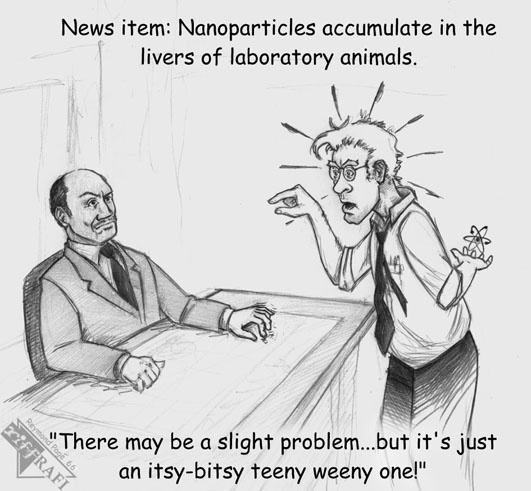
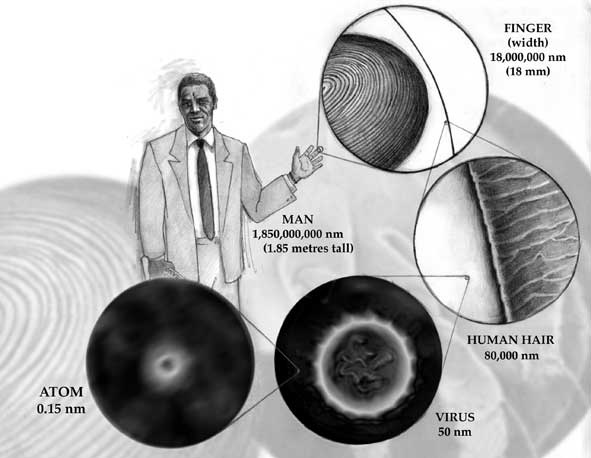
"I read somewhere, if you ask 100 scientiest for a definition of nanotechnology, you will get 100 different answers."
Submitted by ETC Staff on
International efforts to address the food, energy and climate crises give technology a central role to play. While some technologies may offer potential solutions to specific problems, decades of accelerating technological development and deployment have done little to mitigate climate change, and, in many cases, have made problems worse.
Now, new high-risk technologies, ranging from the very small (synthetic biology, genomics, nanotechnology) to the very large (geoengineering), are rapidly developing. Their promoters promise that these technologies are key to solving climate change,
world hunger, energy shortages and biodiversity loss. The precautionary principle and social and economic impacts are often ignored in the rush to deploy the latest technofix, marketed as socially useful and cutting edge, such as “climate-smart agriculture” or “next-generation biofuels.” Without the strict application of the precautionary principle, and a transparent and participatory form of technology assessment, new technologies could wreak even more havoc on a fragile planet that is already under immense strain due to reckless and unsustainable forms of production that serve the few at the expense of the many.
Submitted by ETC Staff on
he most dramatic technological transformation in history – involving information technologies, biotechnologies and engineering – has occurred since the first Rio Earth Summit in 1992; during the same period, however, governments have systematically downsized or eliminated their capacity to understand science and monitor technologies. While technology has thus far played an extraordinarily prominent role in preparatory documents for Rio+20, technology’s potential contribution to sustainable development and/or new Green Economies cannot be realized as long as the world lacks trusted and transparent mechanisms – at global, regional and national levels – for technology evaluation. The absence of such mechanisms incites distrust and invites disaster.
This roundtable discussion with Pat Mooney was organized jointly by the What Next Forum and The Resilience and Development Programme (SwedBio) at Stockholm Resilience Centre.
All together 19 persons, with backgrounds in civil society, the Swedish Ministry for Environment, the Swedish EPA, the research community and sustainable development consultancy participated in a rich discussion, initiated and inspired by an overview by Mooney.
Submitted by ETC Staff on
International effort to address the food, energy and climate crisis tend to regard technology as an important part of the solution. This optimism about technology also prevails in debates around the Green Economy and international environmental governance. And of course technology does hold some potential solutions to some important problems. However, two decades of accelerating technological development and deployment, in the context of massive trade and investment liberalization, has left the globe in far worse straits than it was when the very concept of sustainable development was in its infancy. And now, it is time for a technological te-think. New high-risk technologies, ranging from the very small (synthetic biology, nanotechnology) to the very large (geoengineering), are rapidly developing. Their promoters promise that they hold the keys to solving climate change, world hunger, energy shortages and biodiversity loss and the precautionary principle and social and economic impacs are often ignored in the rush to deploy the latest technofix.
Submitted by ETC Staff on
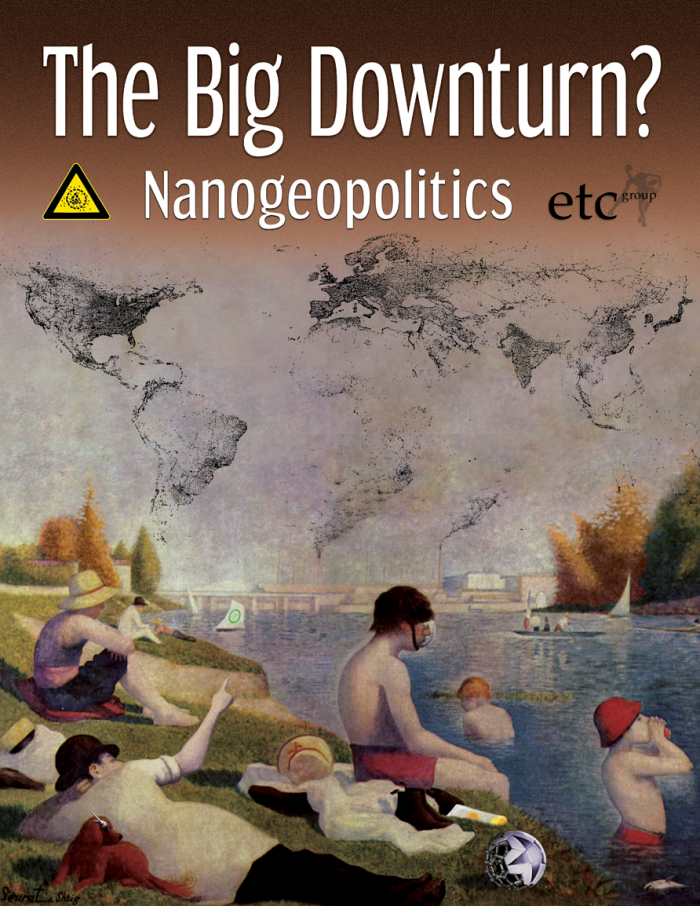
ETC Group brings a new report – "The Big Downturn? Nanogeopolitics" to the conversation at the World Social Forum in Dakar, Senegal, 2011. ETC Group’s 68-page report provides a current snapshot of global investment, markets, governance and control of nanotechnology, including patenting.
Submitted by ETC Group on
The Big Downturn? Nanogeopolitics, ETC Group’s new 68-page report on global governance of nanoscale technologies, is an update of our 2005 Nanogeopolitics survey. In the intervening five years, policymakers – some kicking and screaming – have begun to acknowledge that fast-tracking nanotech has come at a price and that some sort of regulation is needed to deal with at least some of the risks nanoscale technologies pose.
Submitted by ETC Staff on
New technologies and the threat to sovereignty in Africa
Submitted by ETC Staff on
On the eve of UN Mother Earth Day, over sixty national and international organizations today threw their weight behind a common statement launching a global campaign to prevent real world deployment of geoengineering experiments.
Geoengineering refers to large-scale intentional tinkering with the climate and earth systems to counteract global warming. The ‘Hands Off Mother Earth’ campaign (or H.O.M.E. campaign) regards such geoengineering schemes as dangerous and unjust. It is urging individuals and organizations to speak out in opposing them.
Submitted by ETC Staff on
Find out more about ETC Group, or contact us.