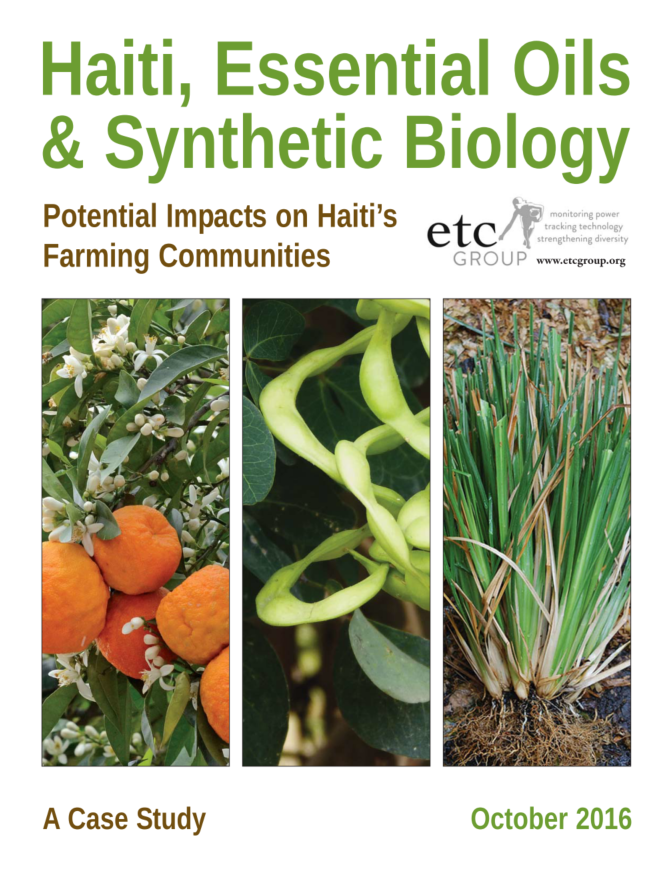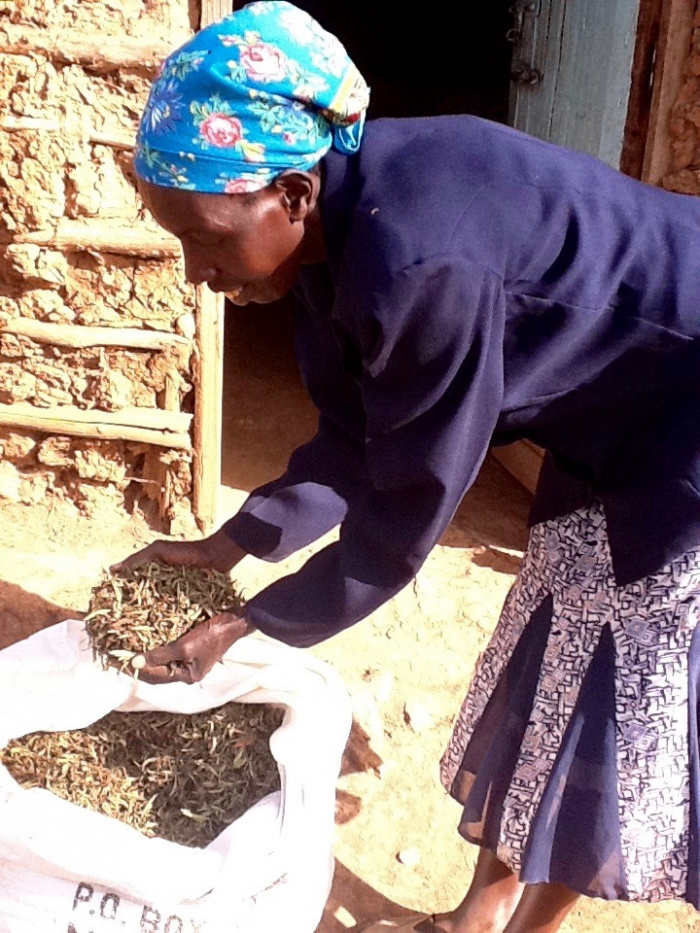
Haiti, Essential Oils & Synthetic Biology
Submitted by Trudi Zundel on
Submitted by Joana Chelo on
Wednesday’s confirmation that Monsanto and Bayer have agreed to a $66 billion merger is just the latest of four M&A announcements, but at least three more game-changing mergers are in play (and flying under the radar). The acquisition activity is no longer just about seeds and pesticides but about global control of agricultural inputs and world food security. Anti-competition regulators should block these mergers everywhere, and particularly in the emerging markets of the Global South, as the new mega companies will greatly expand their power and outcompete national enterprises. Four
Submitted by Anonymous on
OAHU, HAWAI'I — As thousands of government representatives and conservationists convene in Oahu this week for the 2016 World Conservation Congress, international conservation and environmental leaders are raising awareness about the potentially dangerous use of gene drives — a controversial new synthetic biology technology intended to deliberately cause targeted species to become extinct.
Submitted by Trudi Zundel on
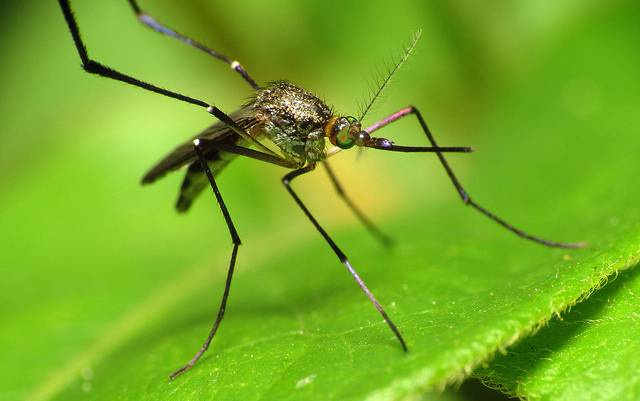
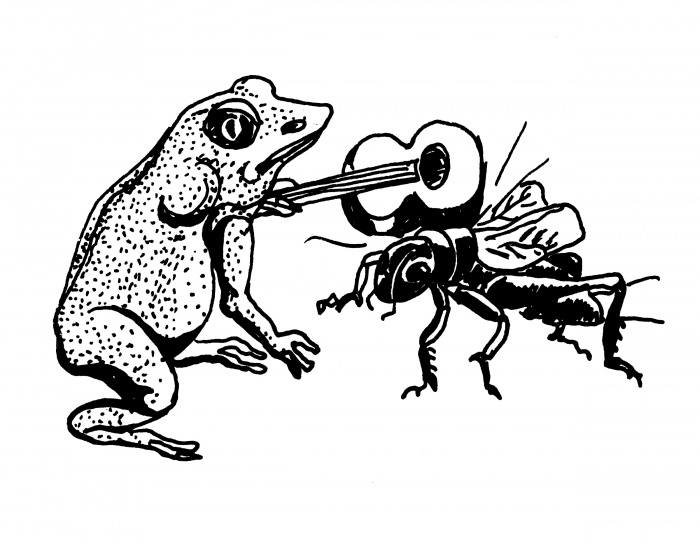
Imagine that by releasing a single fly into the wild you could genetically alter all the flies on the planet—causing them all to turn yellow, carry a toxin, or go extinct.
Submitted by Silvia Ribeiro on
Since August 1st, the news is spreading that Monsanto had to abandon the construction of one of the biggest factories in the world for producing transgenic seed that was to be installed in Córdoba, Argentina, in the municipality of Malvinas Argentinas. From there they had planned to distribute seeds to Latin America and beyond. This is an occurrence of enormous importance, that the company has not wanted to admit publicly, because the reason for their exit is the persistent popular resistance from neighbourhoods, youths and mothers, who have blocked the factory since 2013.
Submitted by Trudi Zundel on
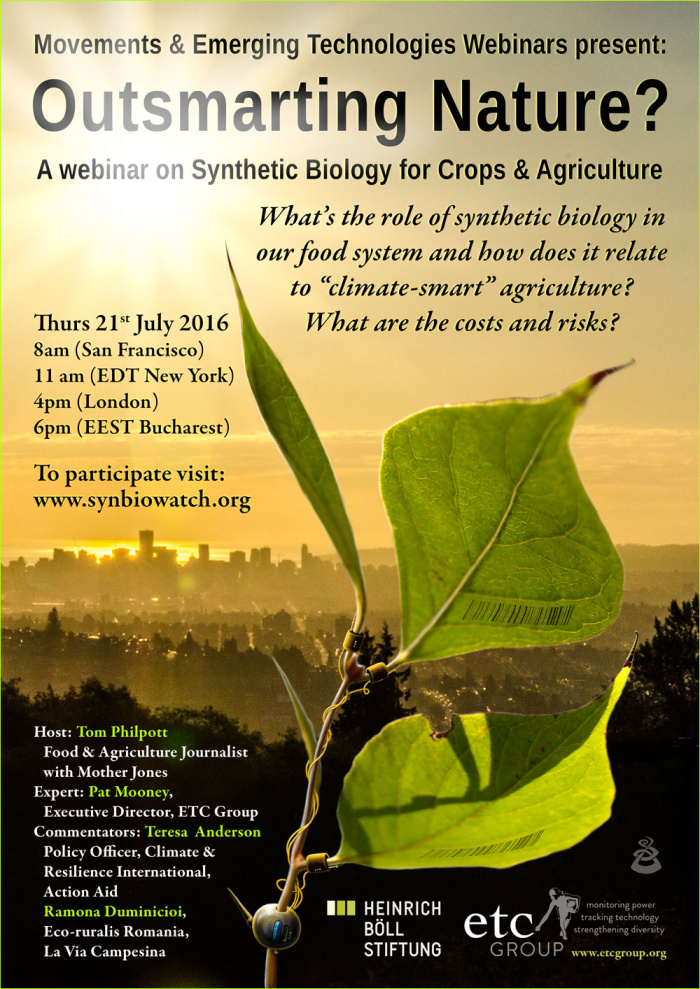
What’s the role of synthetic biology in our food system and how does it relate to “climate-smart” agriculture? What are the costs and risks?
Available to watch at http://www.synbiowatch.org/2016/07/outsmarting-nature-webinar/
Submitted by Silvia Ribeiro on
By Silvia Ribeiro*
It is not often that so many prominent scientists reveal their ignorance on a topic in such a short space. This was the case for the public letter that a hundred Nobel laureates published on June 30th defending genetically modified organisms (GMOs), particularly the so-called “Golden Rice,” and attacking Greenpeace for its critical stance on these crops. The letter is so full of high-sounding adjectives and epithets, false claims and poor arguments that it seems more like a propaganda tirade from transgenic companies than scientists presenting a position.
Submitted by Jim Thomas on
Jim Thomas
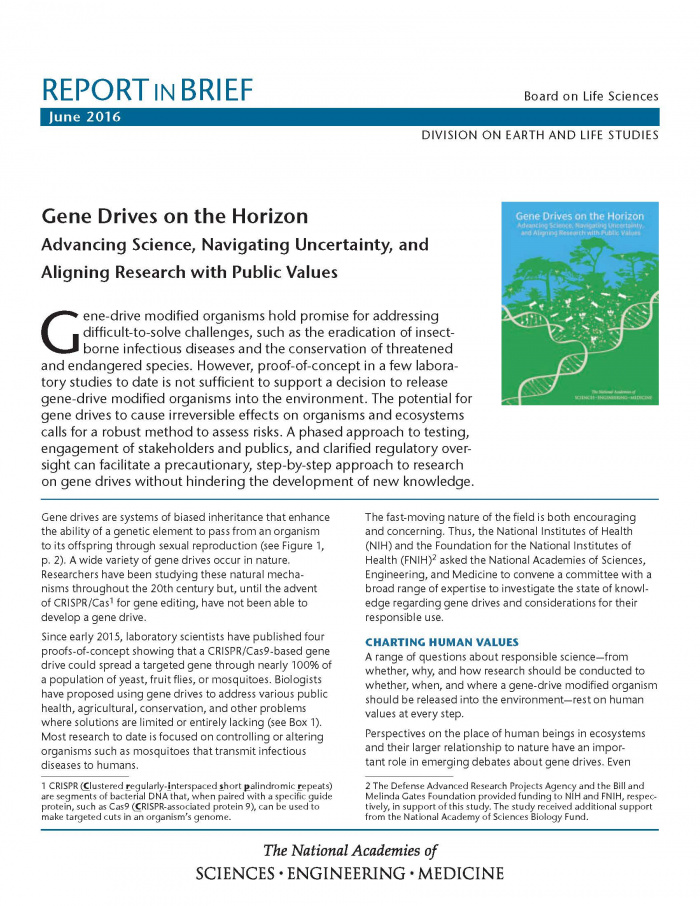
‘Gene drives’ seem to be the ultimate high-leverage technology. Yesterday’s report from the US National Academies begun the job of describing what is at stake, but it missed some important questions.
Jim Thomas is programme director at the ETC Group
Submitted by Joëlle Deschambault on
Coming in at over 200 pages, today’s National Academy of Sciences (NAS) report, 'Gene Drives on the Horizon’ is weighty but disappointing. It fails to properly address three of the most pressing issues raised by the controversial new technology of CRISPR-CAS9 gene drives. Dubbed, the ‘mutagenic chain reaction’ by its inventors, RNA-guided gene drives are a high-leverage synthetic biology technology invented only last year.
Submitted by Joëlle Deschambault on
Synthetic Biology, according to its proponents, is moving at five times the pace of Moore’s law – basically doubling its capabilities and halving its costs every four months. Except that brash billionaire Craig Venter, often dubbed Bioscience’s Bad Boy, is no Gordon Moore. Venter has just announced that his team has produced Synthia 3.0 – the simplest human-made and self-replicating lifeform ever. Synthia 1.0 was announced – after years of delays – in 2010 and its second coming in this new form has been awaited ever since. Synthia 2.0 slipped by without notice – apparently not much to talk about – but this new version is being hailed by at least some synthetic biology scientists as a breakthrough.
Submitted by Silvia Ribeiro on
The data on which is based the declaration of international emergency for the Zika virus are striking for the lack of evidence to motivate such a pompous statement by the World Health Organization (WHO) in the face of a mild illness, with very little evidence of connection with more serious ailments and without scientific proof.
Submitted by Joëlle Deschambault on
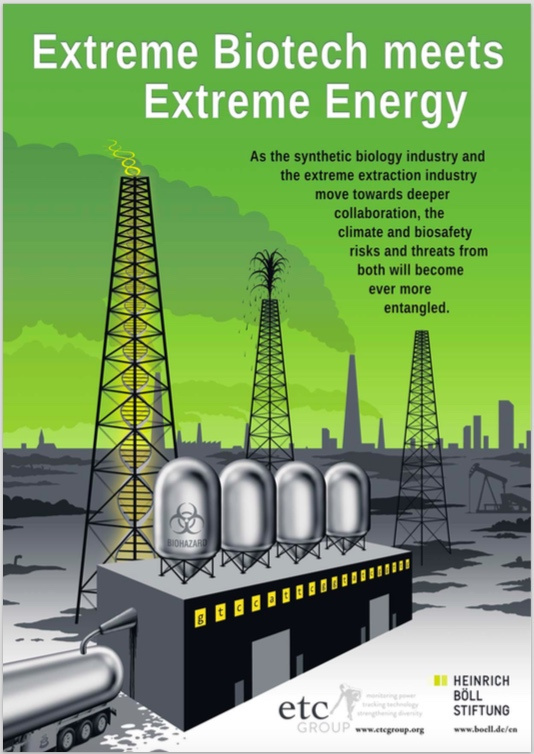
As the synthetic biology industry and the extreme extraction industry move towards deeper collaboration, the climate and biosafety risks and threats from both will become more entangled.
ETC Group and Heinrich Böll Foundation are releasing new language versions of a ten minute animated introduction to Synthetic Biology. Titled “What is Synthetic Biology ? : Engineering life and livelihoods” this short explainer cartoon, drawn by award-winning Canadian animator Marie-Josée Saint-Pierre and produced by documentary filmmaker Jocelyne Clarke was previously only available in English but is now available in French, Spanish, Portuguese and German.
Submitted by ETC Group on
Las Vegas seems to be an apt place to launch a risky corporate gamble that could destroy the livelihoods of millions of small-scale farmers. Earlier this month, the international food conglomerate Cargill chose the city’s famous Strip to introduce what it hopes will be its next blockbuster product: EverSweet, a sweetener made of “the same sweet components in the stevia plant.”
And yet, despite Cargill’s heavy reliance on stevia in its promotional material, EverSweet does not contain a single leaf of the plant. Cargill’s new product is an example of synthetic biology, a form of genetic engineering that uses modified organisms to manufacture compounds that would never be produced naturally. What makes EverSweet taste sweet is not stevia; it is a compound produced by a bioengineered yeast.
Submitted by ETC Group on
Today, six corporations control global markets for industrial seeds/agrochemicals. They determine the priorities and future direction of agricultural research. What are implications of ag mega-mergers for food sovereignty and climate change? What can be done?
Submitted by Joëlle Deschambault on
At a time when just three corporations – Monsanto, DuPont and Syngenta – control 55% of the world’s commercial seeds, industrial farming interests in the Brazilian Congress have introduced a bill that aims to overturn the country’s 10-year old ban on Terminator technology – seeds that have been genetically modified to render sterile seeds. The technology is designed to secure corporate profits by eliminating the age-old right of farmers to save and re-plant harvested seeds.
Submitted by Dru Oja Jay on
FOR IMMEDIATE RELEASE
OTTAWA, Feb 9 2015 — As the climate crisis deepens and political and economic leaders remain in a state of paralysis, geoengineering is increasingly being advanced as a potentially “necessary” action; if recent attempts at opinionmaking are to be believed, it has gone from unthinkable to fundable. And yet, public opinion and much of the scientific community considers geoengineering technologies to be risky and more likely to aggravate than resolve the climate crisis.
Submitted by Dru Oja Jay on
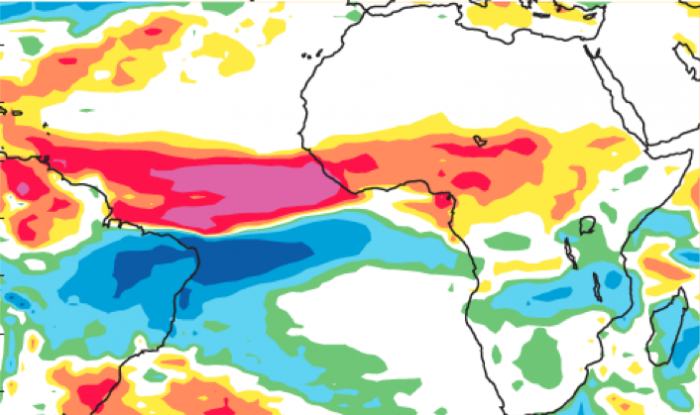
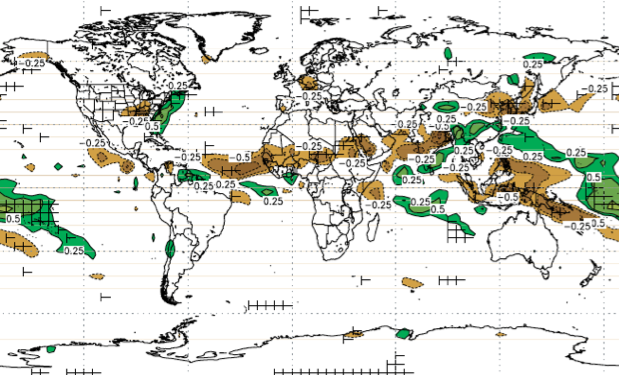
Some governments are exploring geoengineering as a way to reduce or delay climate change. Geoengineering could technically take climate decisions away from all but the richest countries. Computer models show that stratospheric interventions to reduce sunlight and lower temperatures may benefit some temperate zones but negatively impact Africa with important social and agricultural consequences.
Submitted by Dru Oja Jay on
Some governments are exploring geoengineering as a way to reduce or delay climate change. Geoengineering could technically take climate decisions away from all but the richest countries. Computer models show that stratospheric interventions to reduce sunlight and lower temperatures may benefit some temperate zones, but negatively impact Asia’s monsoons with important social and agricultural consequences.
Find out more about ETC Group, or contact us.